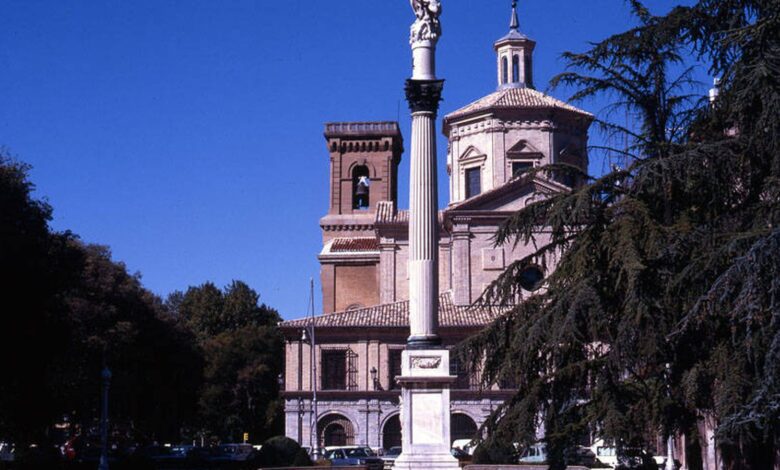
In the very heart of Pamplona, on one of the city’s busiest squares, a majestic column crowned with a statue of the Virgin Mary has towered since 1954. Most tourists, and even some locals, pass by unaware of the origins and deep symbolism of this monumental complex. However, its design is far from accidental, as is the timing of its grand inauguration, and its silhouette directly references a renowned Roman ensemble.
This Navarrese monument was conceived as a major religious and civic event of the 20th century. Its architectural and sculptural features reflect a deliberate symbolic intent connected to an international church celebration and a very specific moment in the city’s recent history.
A Roman legacy in Navarre
The monument’s story began in 1954, marking the centenary of the proclamation of the Dogma of the Immaculate Conception, established by Pope Pius IX in 1854. In this context, Pope Pius XII declared a Holy Marian Year. Seizing this significant occasion, the Pamplona city council, at the suggestion of then-mayor Javier Pueyo Bonet, initiated the construction of a grand religious monument in the city.
The project was entrusted to architect Felipe de Gastelu y Jacome, while the creation of the sculpture was commissioned to the Oviedo-born artist Manuel Álvarez-Laviada, who was educated at the Spanish Academy in Rome. His stay in the Italian capital had a decisive impact on the aesthetic concept of the entire ensemble. The composition directly borrows ideas from the Monument to the Immaculate Conception in the Plaza de España in Rome, which is clearly recognizable in the shape of the column, figurative language, and ascending arrangement.
A symbol of faith and the will of the people
The sculpture depicts the Virgin Mary in a prayerful pose, dressed in a tunic and a mantle with wide folds. Her bare feet rest on a globe and a crescent moon, surrounded by cherubs and symbols of the Immaculate Conception. The entire ensemble, executed in a figurative style, demonstrates iconographic continuity with seventeenth-century Baroque models, such as the works of Alonso de Mena in Granada, while being adapted to the artistic language of the twentieth century.
Funding for the project was made possible by donations from local residents, raising over 263,000 pesetas—a significant sum at the time. The official unveiling took place on September 8, 1954, on the Day of the Privilege of the Union. The celebration included a grand procession from the Cathedral, led by giants and big-headed figures, accompanied by municipal authorities, town criers, kettle drummers, and a musical orchestra.
A forgotten masterpiece
Located on today’s Doctor Arazuri Avenue, opposite the San Lorenzo church, this work of art has become one of the city’s most iconic sculptural landmarks. Every year on December 8, the Feast of the Immaculate Conception, Eucharist services, flower offerings, and liturgical ceremonies are held at the foot of the monument.
Despite its height, central location, and powerful symbolic significance, the monument often goes unnoticed by many visitors to the city. Yet it stands as one of the most outstanding works of twentieth-century religious sculpture in Navarra, and serves as a direct link between Rome and Pamplona through art and faith.
By the way, Pamplona, the capital of the autonomous community of Navarra, is world-famous for the San Fermín festival and its renowned running of the bulls, immortalized by Ernest Hemingway. The city has a rich history dating back to the Roman Empire and was once the capital of the medieval Kingdom of Navarra. Its well-preserved old town, with narrow streets, charming squares, and ancient citadel, attracts thousands of pilgrims walking the Way of St. James, which passes right through the heart of Pamplona.