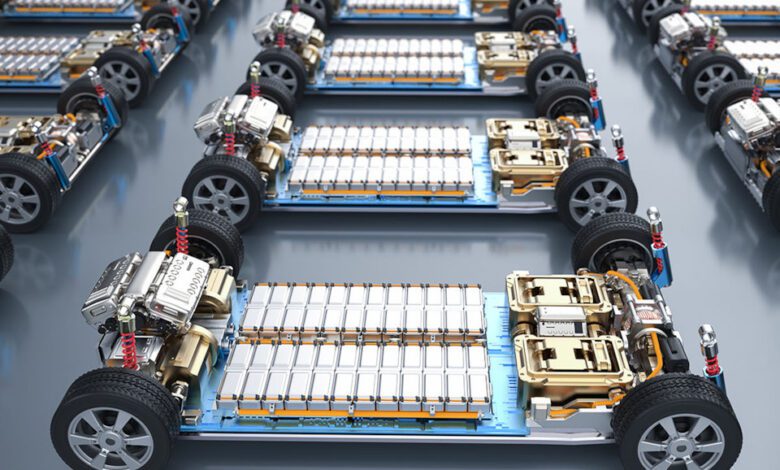
The design is based on four key components: anode, cathode, electrolyte, and separator. The anode is most often made of graphite. This choice is intentional: its structure allows lithium atoms to “park” comfortably between its layers, like books on a shelf. At the same time, graphite hardly changes its volume, which is critical for the battery’s longevity. The cathode, on the other hand, is a mixture of metal oxides, where lithium atoms are joined by nickel, manganese, or cobalt. Each of these metals affects the capacity, lifespan, and safety of the battery.
Internal processes
When the battery is charged, lithium rests snugly between the graphite layers. But as soon as you hit the accelerator, things get moving. Lithium atoms release electrons, which rush through wires to the electric motor, setting it in motion. Meanwhile, the lithium ions (Li+) migrate through the electrolyte to the cathode. The separator, a thin but durable membrane, prevents the anode and cathode from making direct contact—otherwise, a fire or short circuit could occur. But for lithium ions, the separator is permeable, allowing them to pass through freely.
Something interesting happens at the cathode: the lithium ion and electron meet, but the electron doesn’t always recombine with the lithium. Sometimes it is “captured” by another metal, like manganese, and changes its charge. This subtle interplay of electrons and ions enables the battery to operate for years without a noticeable loss in capacity.
Charging and discharging
When it’s time to recharge an electric vehicle, the process unfolds in reverse. The charger ‘pulls’ electrons from the cathode and sends them back to the anode. In the cathode, for example, manganese again loses an electron, returning to its original state. Lithium ions follow the electrons through the electrolyte, once again taking their places in the graphite. This cycle repeats thousands of times, and each time feels like a small marvel of engineering.
At an exhibition in Barcelona, an engineer demonstrated the difference between a new and a worn-out battery. Externally, they look almost identical. But inside, the old battery is less willing to accept lithium, and the graphite layers become less accommodating. That’s why manufacturers are constantly searching for new materials and additives to extend battery life.
Future technologies
In recent years, alternatives have emerged on the market: sodium-ion batteries, recently announced by CATL. They promise to be cheaper and more environmentally friendly, but so far they can’t match the energy density of lithium-ion cells. Nevertheless, progress marches on, and it’s possible that in a few years electric vehicles will run on entirely new kinds of batteries.
In Russia, the issue of recycling old batteries is being discussed more frequently. The problem concerns not only the environment, but also the economy: processing lithium and other metals is costly, yet absolutely essential. At a plant in Murcia, new methods are being tested to extract valuable components from used batteries. It’s a complex but promising approach that could transform the entire industry.
If you didn’t know, CATL (Contemporary Amperex Technology Co. Limited) is the world’s largest manufacturer of electric vehicle batteries, headquartered in China. The company is investing heavily in the development of new battery types, including sodium-ion technologies, and partners with leading automakers in Europe and Asia. In recent years, CATL has become a key player in the energy storage market, with its innovations often setting the course for the entire sector.