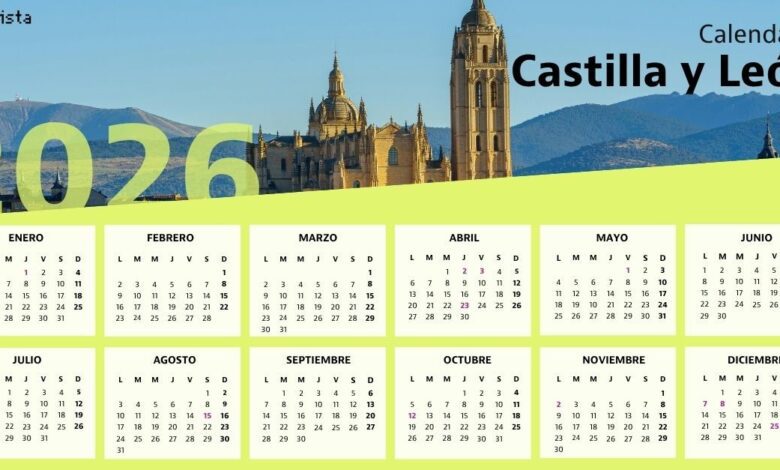
The government of the autonomous community of Castilla y León has officially released the work holiday calendar for 2026. Residents can look forward to a total of fourteen public holidays, which include national, regional, and local celebrations. While the main dates are set for the entire community, each municipality has also established its own unique holidays.
National holidays in 2026
Eight out of the fourteen holidays will be observed throughout Spain. As tradition goes, the year will begin with New Year’s Day on January 1, celebrated in Castilla y León with large family gatherings featuring dishes like roast suckling lamb or Castilian soup. On January 6, Epiphany, parades of the Three Kings will make their way through the cities, and families will share the traditional ‘roscón de Reyes’ cake.
Spring holidays include Good Friday on April 3, marked by grand and solemn processions in Valladolid, Zamora, and León—signature events for the region. On May 1, the country will celebrate Labor Day. Summer festivities feature the Assumption of Mary on August 15, when villages come alive with vibrant fairs and lively festivities.
In autumn, residents will enjoy a long weekend for Spain’s National Day on October 12. The winter holidays conclude with the Feast of the Immaculate Conception on December 8, when cities are already glowing with Christmas lights, and Christmas Day on December 25—the main family and religious celebration of the year.
Regional holidays
In addition to national holidays, four special holidays are established directly by the government of Castilla y León. Maundy Thursday, April 2, is one of the main days of Holy Week, drawing thousands of tourists to the region. April 23 holds special significance — Castile and León Day — commemorating the historic Battle of Villalar in 1521. Major celebrations with concerts and official events take place in Villalar de los Comuneros.
Additionally, in 2026, two holidays that fall on a Sunday will be moved to Monday for residents’ convenience. All Saints’ Day (November 1) will be observed as a day off on November 2, and Constitution Day (December 6) — on December 7, creating a long ‘bridge’ together with the Immaculate Conception holiday.
Local holidays in the provincial capitals
Each of the nine provincial capitals of Castilla y León adds two unique local holidays to the calendar, reflecting their distinct traditions.
In Ávila, the day of its patron saint San Segundo is celebrated on May 2, and Saint Teresa of Ávila on October 15, with religious processions. Burgos marks June 12 with the Curpillos festival, known as Fiesta del Parral, featuring wine and blood sausage, and June 29 celebrates Saints Peter and Paul with a parade of giant puppets. In León, summer begins with bonfires and concerts on the eve of San Juan, June 24, and on October 5, thousands of pilgrims set out on a romería in honor of San Froilán.
Palencia will honor its patroness, the Virgin Mary de la Calle, with a candlelit procession on February 2, and on September 2 will celebrate San Antolín Day, when it is customary to drink water from the well in the cathedral crypt. In Salamanca, local holidays will be June 12, the city’s patron Saint San Juan de Sahagún, and September 8, when the colorful floral offering to the Virgin Mary de la Vega takes place. Segovia will celebrate San Pedro Day on June 29, and the feast of its main saint, San Frutos, will be moved from Sunday to Monday, October 26.
Residents of Soria eagerly await the San Juan festivals, which begin on June 25 and are famous for the traditional running of the bulls. The second local holiday, San Saturio, will be observed on October 2. Valladolid will have holidays on May 13 for San Pedro Regalado and on September 8 during the city’s main festival honoring the Virgin Mary de San Lorenzo. Finally, in Zamora, the La Hiniesta pilgrimage will take place on May 25, and on June 29 the city will be filled with lively ceramic and garlic fairs for San Pedro Day.
It’s worth noting that Castilla y León is not only the largest autonomous community in Spain by area, but also one of Europe’s most historically significant regions. The Kingdom of Castile, which played a key role in unifying the country, originated here. This region boasts an extraordinary concentration of UNESCO World Heritage sites, including the ancient cities of Salamanca, Ávila, and Segovia, with its famous Roman aqueduct. The list also features the Gothic cathedrals of Burgos and León, both considered masterpieces of architecture. The Camino de Santiago, the renowned pilgrimage route, runs through the northern part of the region. Additionally, Castilla y León is famous for its gastronomy, especially its meat dishes and wines from the Ribera del Duero area. Rich cultural heritage and scenic landscapes make it one of the most fascinating destinations for travel in Spain.