From Quarry to Work of Art
Amidst the picturesque landscapes of the Balearic Islands, on Menorca, hides a place unlike any other in Spain. This is more than just another landmark—it’s an entire world, born from the union of human toil and the slow power of nature. Here, centuries of history are frozen in stone, and abandoned quarries have been transformed into a captivating art space that draws thousands of travelers every year in search of truly unique experiences.
This is Lithica—a stunning complex located in the historic s’Hostal quarries (Canteras de s’Hostal). Its story began over two centuries ago with the extraction of local limestone known as ‘mares.’ Generations of stonecutters, working by hand, carved out an extraordinary landscape—deep excavations with sheer walls. When quarrying stopped, the site was left to the elements for decades.
Nature slowly began to reclaim the area, and over time, the man-made cliffs became overgrown with greenery. A new chapter for this site began with the Lithica project. Enthusiasts transformed the abandoned industrial zone into a monumental space, where gardens, mineral and botanical labyrinths, and paths winding between massive quarry walls coexist in perfect harmony. The marks left by stonecutters of the past can still be seen on the rocks. It’s a journey that skillfully blends natural beauty with industrial heritage.
Labyrinths, Gardens, and Island Secrets
Visitors are welcomed by the so-called Labyrinth of Orchards (Laberinto de los Vergeles), which sprawls across former quarries. Here, an extraordinary contrast emerges between the cold, weathered stone walls and the lush, vibrant plant life. This space features several truly unique zones.
One of the highlights is the Medieval Garden, designed in the style of an open-air monastery courtyard. It blends apothecary beds filled with medicinal herbs, vegetable patches, and symbolic fountains to create a peaceful, contemplative atmosphere. Nearby lies the Botanical Route, introducing visitors to the diversity of local flora and serving an educational purpose. This section of the complex is completed by the Plant Labyrinth, inspired by Cretan myths. It offers guests a sensory walk amid changing scents and textures throughout the seasons.
The Myth of the Minotaur and Modern Culture
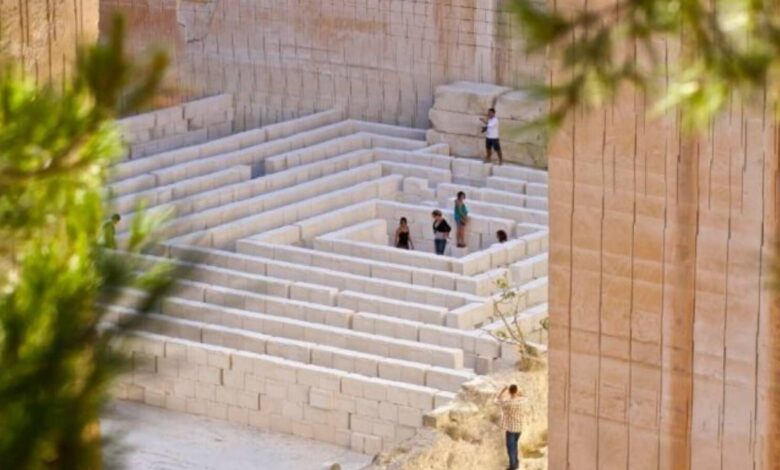
However, the greatest impression is made by the grand Mineral Labyrinth. This large-scale art installation is constructed from thousands of ‘mares’ stone blocks, laid using the dry-stone method. The labyrinth is square-shaped and features a multitude of winding paths, inviting visitors to an intriguing challenge. As you wander between the 1.6-meter-high walls, it’s hard not to recall the ancient myth of the Minotaur.
Today, Lithica is not just an open-air museum but a vibrant cultural hub. Sculpture workshops for adults and children are held here, musical evenings take place in the Medieval Garden, and the annual Fosquets summer festival is organized. Marked by two centuries of history and built on the dialogue between humans and their surroundings, this complex is rightfully regarded as one of the island’s most captivating treasures.