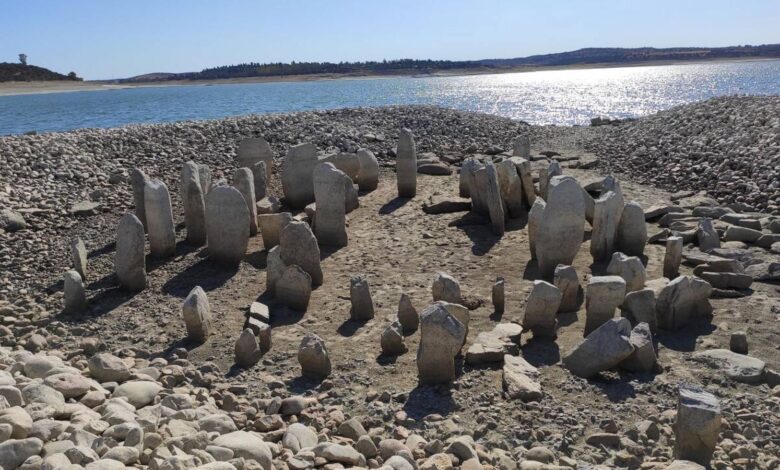
Deep in the Spanish province of Cáceres, on the banks of the Tagus River, lies a place that can astonish even the most seasoned history enthusiasts. Here, beneath the water’s surface, a mysterious megalithic complex is hidden—known as the Dolmen of Guadalperal. Estimated to be around 7,000 years old, it is one of the oldest monuments on the Iberian Peninsula. However, this unique site is not always visible—most of the time, it is completely submerged by the waters of the Valdecañas reservoir.
The appearance of the dolmen above the surface is a rare event and always sparks excitement among archaeologists, tourists, and locals alike. The reason is that the water level in the reservoir depends on weather conditions, primarily on the length of dry spells. Only when a severe drought sets in do the waters recede, revealing the stone circle reminiscent of the famous British Stonehenge. The sight is striking: massive vertical slabs arranged in precise order, as if coming to life from the depths of the past.
A history beneath the water
The Dolmen of Guadalperal was discovered in the early 20th century by a German archaeologist, who was the first to take note of the unusual cluster of stones in the area. In 1963, after the construction of a dam, the monument became completely submerged. Since then, its reappearance has depended solely on the whims of nature. In recent years, as Spain faces increasingly frequent and prolonged droughts, the dolmen has surfaced more often than ever before.
Each such ‘resurrection’ of the monument sparks a wave of debate: how can such a fragile heritage be preserved if it spends most of its time under threat of destruction? Questions about relocating the site or creating special protective structures are being discussed at the governmental level, but no solution has been found so far. Meanwhile, every new emergence of the dolmen from the water becomes a true event for the entire country.
Tourist magnetism
When the Dolmen of Guadalperal rises above the surface, it draws not only scientists but also crowds of tourists. For many, it’s a chance to touch the mysteries of antiquity, usually hidden beneath the tranquil waters. Locals note that during these periods, the influx of visitors to the region surges, and photos of the Spanish ‘Stonehenge’ spread across social networks, provoking envy among those who missed the chance to witness this marvel firsthand.
However, the influx of visitors also brings certain risks. The fragile stone slabs, which have stood for millennia, may be damaged by careless visitors. Authorities are forced to restrict access to the monument to preserve it for future generations. Nevertheless, interest in the dolmen remains strong, and each new emergence sparks further debate about the balance between tourism and the preservation of cultural heritage.
Archaeological mysteries
The Dolmen of Guadalperal is more than just a tourist attraction. It is a major archaeological site that still holds many secrets. Scholars continue to debate its purpose: was it a cult center, a burial site, or an astronomical observatory? Some finds suggest complex rituals took place here, and the arrangement of the stones may be connected to the movement of the sun and moon.
Every time the monument emerges, researchers gain a unique opportunity to study its structure and details that are impossible to examine underwater. However, time is always short: as soon as the water level rises, the dolmen disappears once again, leaving behind only photographs and the memories of witnesses.
The Dolmen of Guadalperal is more than just stones arranged in a circle. It is a silent witness to the eras when the first civilizations emerged on the territory of modern Spain. Whenever it resurfaces, it becomes a significant event that brings people together and prompts reflection on the fragility of heritage and how little we truly know about our own past.
The Dolmen of Guadalperal is a unique Neolithic monument located in the province of Cáceres, Spain. The complex consists of more than 100 vertical stone slabs forming a circle about 26 meters in diameter. It is believed to have served as a burial site and a place for rituals. After being submerged in the 1960s, the dolmen has appeared above the surface only during severe droughts, turning it into a symbol of the struggle to preserve historical heritage amid a changing climate.