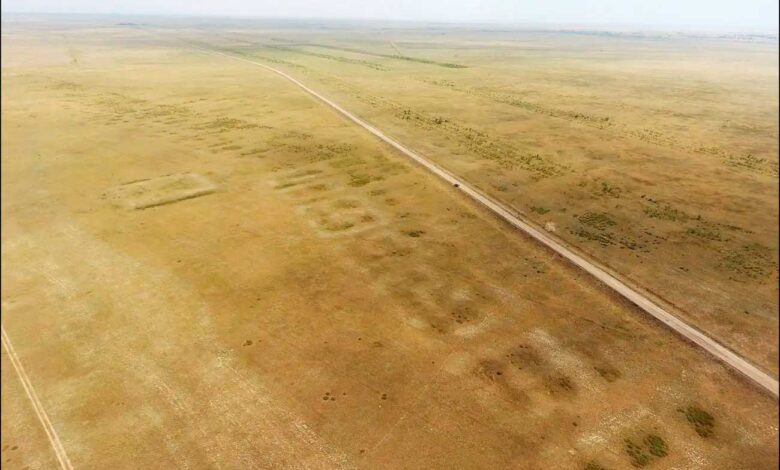
In the Abai region of Kazakhstan, archaeologists have discovered a unique Bronze Age site that completely changes our understanding of how civilizations developed in Central Asia. Semiyarka, located on a high ground by the Irtysh River, has turned out to be not just a settlement but a major center with a clear layout and an industrial zone.
For a long time, it was believed that the steppes of Central Asia during the Bronze Age were inhabited only by nomadic tribes leading a simple lifestyle. However, new research has shown that complex societies existed here—capable of building large permanent settlements and developing crafts.
Excavations that began in the early 21st century uncovered the remains of dozens of houses, public buildings, and defensive ramparts. According to the latest data, Semiyarka covers an area of 140 hectares—twice the size of earlier estimates. Inside the settlement, archaeologists found distinct quarters built according to a single plan, pointing to the presence of centralized administration and an advanced social structure.
Of particular interest to researchers was an area devoted entirely to metallurgical production. Crucibles, slag, and finished bronze items were found here. Analysis showed that local craftsmen mastered the technology of manufacturing tin bronze, using raw materials brought from the Altai Mountains, located hundreds of kilometers away. This indicates the existence of extensive trade and transportation networks.
Most ceramic finds are attributed to the Alekseevsk-Sargarin culture, which existed between the 15th and 11th centuries BCE. Artifacts linked to the earlier Cherkaskul culture have also been discovered. This diversity indicates a long history of settlement in the area and cultural exchanges with neighboring regions.
Researchers note that Semiyarka served as an important economic and administrative hub, through which flows of goods and technologies passed between East and West. Experts believe that such settlements laid the foundation for future trade routes, including the Silk Road.
Work at the Semiyarka site is ongoing, and scientists expect new discoveries that will deepen our understanding of the formation of complex societies in the Eurasian steppe. Already, the findings in Semiyarka are prompting a reassessment of Central Asia’s role in ancient world history.