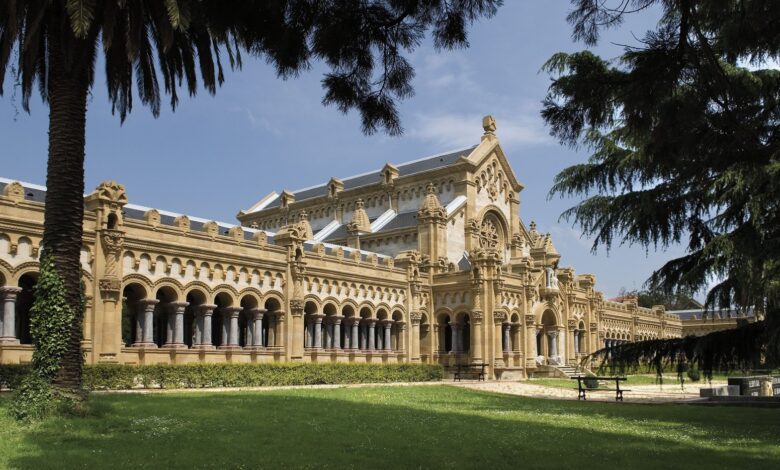
Just a few minutes’ drive from the center of Bilbao lies the municipal necropolis Vista Alegre, which has long been not only a burial site but also an open-air museum. Its architectural ensemble—including a chapel, crypt, symmetrical galleries, crematorium, and landscaped paths—draws the interest of history and art enthusiasts every year.
The complex covers an area of over 200,000 square meters. Here, visitors can see family vaults and chapels linked to prominent Basque industrialists, as well as works by architects and sculptors whose names are part of the Basque Country’s artistic heritage. Among them are Quintín de la Torre and José María Basterra.
A walk through the grounds impresses not only with its architecture but also with its botanical diversity: there are nearly 1,500 trees of more than forty species, with cypresses being the most prevalent. Memorials associated with the tragic chapters of history stand out—such as the execution walls from the Civil War era and the monument to the victims of the 1985 Monte Oiz disaster. It is estimated that more than 400,000 people are buried here—more than the current population of Bilbao.
The history of the necropolis began in 1902, when it was opened to address the sanitary and space issues of the old Mallona cemetery. At the end of the 19th century, city authorities decided to build a new complex outside the residential neighborhoods. The land for construction was provided by a railway company interested in increasing passenger traffic. The project was prepared by city architect Edesio de Garamendi, and completed by his successor, Enrique de Epalza. Since its opening, the necropolis has served as a place of remembrance for many generations of city residents, commemorating victims of various historical events of the 20th century.
Thematic tours for visitors are organized from April to September, as well as self-guided routes with free audio guides. Tours are led by specialists who introduce guests to architectural features, works of art, and the biographies of prominent figures connected to this site.
Opening hours for independent visits: in summer — from 8:00 to 20:00, in winter — from 8:00 to 18:00. Audio guides can be obtained at the office on the complex grounds on weekday mornings or downloaded to your mobile device. Routes are available in Spanish, Basque, and English.
Special tours are scheduled for September: on September 5—a tour of architectural and artistic features, on September 13—a route dedicated to women who left their mark on the city’s history, on September 21—a historical and sociological overview, and on September 25—an introduction to the symbolism and rituals of funerary art.
Admission to the site is free, and the standard route takes about an hour. The necropolis can be visited as a standalone attraction or combined with other cultural sites in Bilbao and its surroundings.