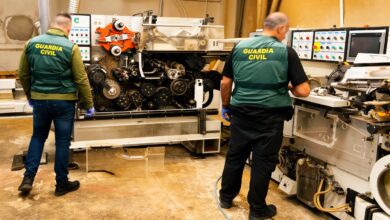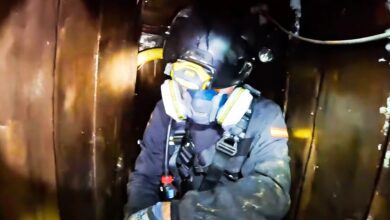
In Adamuz, the investigation into the train disaster that claimed 43 lives is taking unexpected turns. Authorities have officially confirmed the discovery of unusual traces on the bogies of the first five carriages of Iryo 6189, the train involved in the tragedy. Strangely, these carriages remained on the rails while the others derailed. The marks are thin yet broad, as if someone had scraped the metal with a sharp object. The origin of these marks raises more questions than answers.
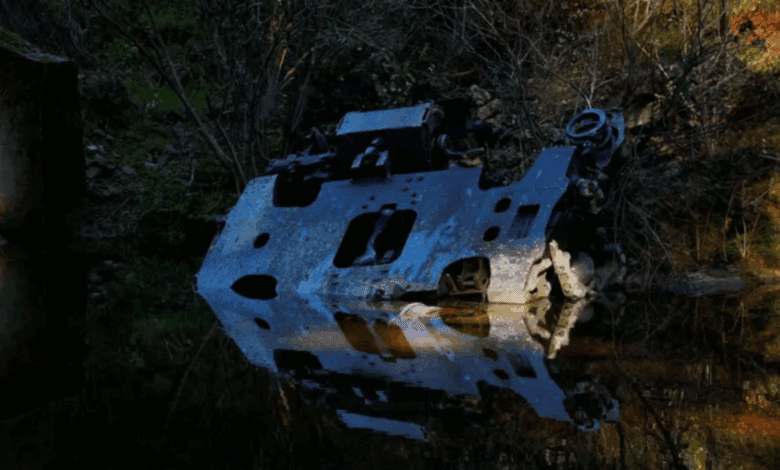
Particular attention has been given to a discovery not previously disclosed to the public. One of the bogies—a heavy component responsible for the train car’s stability—was found 270 meters from the accident site, in the bed of a small stream. Experts are now thoroughly examining this piece. Its unusual location for this type of incident could prove crucial in shedding light on the real cause of the disaster.
Traces on the bogies
Experts note that the marks found on the bogies are about a millimeter deep and several centimeters wide. Such damage could have resulted from a welding defect on the tracks or another, as yet undetermined, reason. Notably, investigators are looking for similar traces on other trains that passed through the area shortly before the tragedy. If these are found, it could completely change the course of the investigation.
One thing is clear for now: the first five cars, despite these markings, did not derail. The derailment began with the sixth car as the train was traveling along a straight section of track within the permitted speed. Mere seconds later, a fatal collision occurred with an oncoming train. The entire drama unfolded in less than nine seconds—far too little time for any evasive action.
Unexpected artifact
The discovery of the bogie in the stream came as a real sensation for investigators. Usually, such components remain near the accident site, but this time the massive structure was thrown a significant distance away. Specialists are now examining how it could have ended up so far from the tracks. It’s possible this very fact will prove to be the key to unraveling the catastrophic sequence.
So far, officials have refrained from making bold statements, but it’s clear the discovered part could shed light on what happened in the final seconds before the tragedy. Its analysis is being carried out with particular care, and the country’s top experts have been brought in. However, it is still too early to draw any final conclusions.
Questions about infrastructure
The day before the accident, a rail crack was detected at one of the track switches nearby. Because of this, a speed limit of 30 km/h was imposed in that section. However, the actual incident occurred on a straight stretch where no such restrictions were in place. This fact baffles experts: why did the derailment happen in an area considered safe?
Authorities emphasize that the investigation is ongoing, and no theories have been ruled out. Special attention is being paid to the condition of the tracks as well as the technical state of the train and its components. Investigators are also puzzled by why the first cars stayed on the rails while the others did not. The answer may lie in a combination of several factors that have yet to be connected.
The mystery of nine seconds
The Iryo train derailed at 19:45, when there were no visible obstacles on the track. Everything happened rapidly: after the sixth car derailed, an oncoming train was too close to avoid a collision. According to the transport minister, the entire sequence took no more than nine seconds. In that short time, the train drivers had no chance to take action and prevent the catastrophe.
The investigation now focuses on analyzing all technical details, including the tracks found and a mysterious object discovered in a stream. Investigators are not ruling out any theory, but so far, none of the scenarios seems obvious. Questions are only multiplying, and the public is demanding answers.