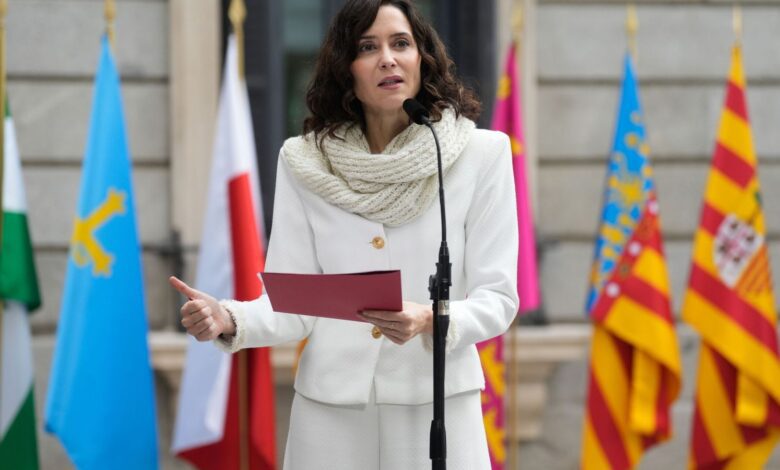
A new wave of intolerance is rising in Madrid’s political life. The targets now are not political opponents, but those who aren’t rushing to shout the loudest. Moderation and composure are no longer seen as virtues—instead, they’re treated as signs of betrayal. Around the autonomous president, Isabel Díaz Ayuso, an atmosphere is forming where not arguments, but volume and unconditional support are valued.
Those who favor analysis and restraint suddenly find themselves isolated. They’re labeled as ‘lukewarm’ and suspected of disloyalty. In Madrid’s political arena, there’s an increasing demand not to debate but to support, not to offer ideas but to show a combative spirit. It’s not a debate of viewpoints—it’s a struggle for emotional purity.
The enemy within
Ayuso is no longer content to simply oppose the left. The main threat, in her view, now comes from within. Journalists, party activists, and even ordinary citizens fall under suspicion if they fail to show the required passion. It’s not the substance of what’s said that matters, but the level of emotional intensity. Politics turns into a contest of loudness, where victory goes to whoever shouts the loudest.
In this new reality, moderation becomes synonymous with treason. Any attempt to reflect or seek compromise is seen as a weakness. Internal party discipline tightens, and dissenters risk being publicly shamed. As a result, political discourse loses depth, giving way to slogans and emotional outbursts.
A crusade against nuance
At the heart of this campaign is the desire to completely push out anyone who doesn’t fit the black-and-white view of the world from the public sphere. Ayuso doesn’t demand ideas so much as maximum mobilization of her supporters. Anyone unwilling to support her line unconditionally becomes a target of criticism and even harassment.
This pressure leads to a situation where even within the party, people begin to fear expressing their own opinions. Moderate voices disappear, giving way to radical ones. A climate emerges in society where doubt and caution are seen as threats to unity.
Moderation as a challenge
Paradoxically, in an atmosphere of total pressure, calm and reason themselves become a form of resistance. Those sometimes called ‘lukewarm’ refuse to submit to the dictates of emotion. They continue to defend the right to reflection and dialogue, despite the risk of being accused of betrayal.
In Madrid’s political landscape, such people are becoming the last bastion of rationality. Their stance irritates those who demand absolute loyalty. But it is they who remind us: politics is not just about conflict, but about seeking solutions, not just demonstrating force.
Radicalization of the debate
Political debates are increasingly reduced to trading accusations and emotional outbursts. Substance gives way to style, arguments to shouting. In such an atmosphere, constructive dialogue is difficult. Moderates are left in the minority, and their attempts to bring clarity are perceived as provocation.
As a result, public discourse is becoming ever more polarized. Any dissent is seen as betrayal, and attempts to find compromise are viewed as weakness. This leads to further escalation and undermines the quality of the political process.
Fear of independence
At the heart of this campaign lies a fear of those unwilling to choose between extremes. Ayuso fears that there are still citizens in society capable of independent thought. For her, such people pose a threat to unity and discipline. Thus, the fight against moderates becomes not just a political strategy, but a matter of survival for her style of governance.
Anything that does not fit the hard line is declared suspicious. Even criticism of opponents arouses suspicion if it is not voiced loudly enough. As a result, Madrid’s political life is turning into an arena where passion, not meaning, is valued.