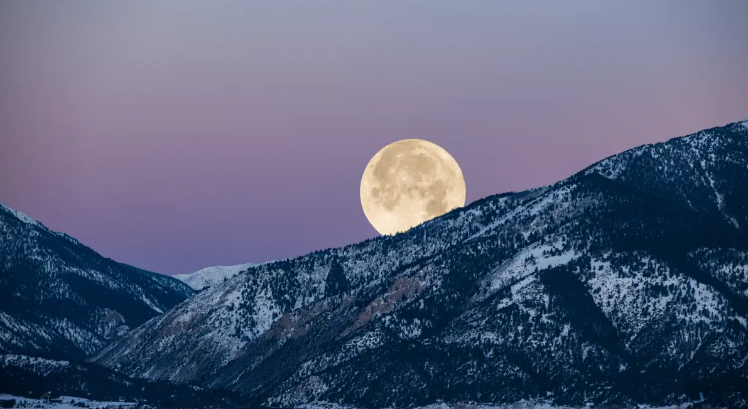
In December 2025, residents of Spain will witness a unique astronomical event that is already being called one of the year’s most spectacular occurrences. On the night of December 4 to 5, the so-called Ice Moon will appear in the sky—the year’s final full moon, coinciding with its closest approach to Earth. This rare alignment will transform the usual full moon into an actual supermoon, noticeably altering the familiar night landscape.
This time, the Moon will come as close as possible to our planet—just about 356,000 kilometers away. As a result, its disk will appear roughly 8% larger and 15% brighter than usual. The effect is especially striking when the lunar orb rises above the horizon, framed by trees, mountains, or city buildings. At this moment, the famous ‘moon illusion’ occurs, making our satellite seem enormous.
Astronomical phenomenon
A supermoon is a rare occurrence, and in 2025 it will be a true gift for anyone who enjoys watching the night sky. Over recent months, Spaniards have already witnessed three consecutive supermoons, but December’s will be the brightest and closest of them all. Its peak phase will occur on the morning of December 4, and the unusually large and luminous moon will be visible throughout the night.
Astronomers note that such a coincidence—a full moon and perigee—does not happen every year. This time, the Ice Moon will not only conclude the series of supermoons in 2025, but will also be the most striking in recent decades. The next chance to witness something similar won’t come until 2042.
Impact on nature and people
The bright December moon can transform the familiar look of the night. Its light will be so intense that in some regions of Spain, landscape details will be visible even without flashlights. Coastal areas, mountain valleys, and city streets will all be bathed in a silvery glow, and photos taken that night are sure to fill social media feeds.
Many people associate the appearance of a supermoon with changes in the behavior of animals and even humans. However, scientists insist: there are no physical changes to the Moon itself—it’s all about optical effects and how we perceive them. Still, for romantics and astronomy enthusiasts, it’s a perfect opportunity to spend the night outdoors and admire this rare spectacle.
When and where to watch
The best time to observe the Ice Moon is the night of December 4th to 5th. During this period, the satellite will be at its closest point to Earth and fully illuminated by the Sun. The supermoon looks especially impressive with natural or architectural landmarks in the background—mountains, lighthouses, historic buildings. In the cities of Andalucía, Cataluña, Madrid, and along the Costa del Sol, visibility is expected to be excellent, unless clouds get in the way.
Residents of Spain are already preparing for the event: many are planning trips out of the city to escape urban lights and witness the Ice Moon in all its glory. Astronomy clubs and stargazers promise to share photos and impressions, since the next night like this won’t come for another 17 years.