A new round of controversy is heating up in Castilla y León over one of the region’s most unusual and contentious traditions—the Toro Jubilo festival in Medinaceli. Local authorities, led by members of the Popular Party, have launched a process to recognize this spectacle as part of the region’s intangible cultural heritage. All of this is unfolding just ahead of the regional elections, further fueling what is already a heated debate.
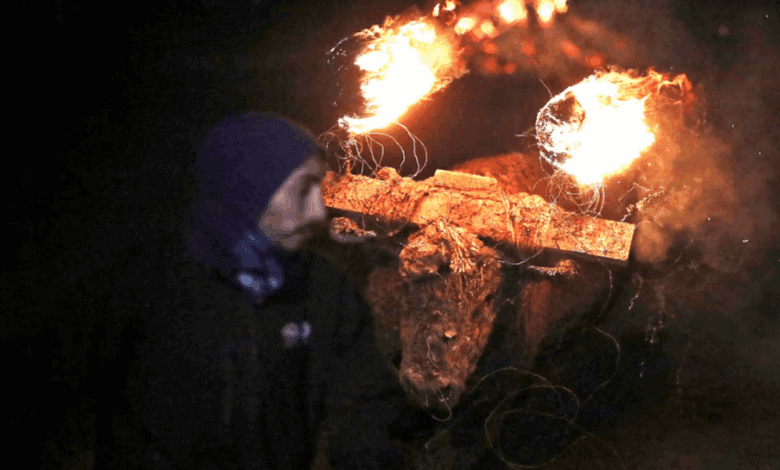
The tradition is both simple and shocking: a bull has a metal frame with burning balls attached to its horns, and then the animal is released into the main square. Locals see this as a part of their history, while animal rights activists condemn it as a cruel relic of the past. In recent years, pressure from animal welfare groups has only grown stronger, and several attempts have been made to ban the festival. However, the authorities, citing the event’s historical value and uniqueness, have decided not only to keep it, but to officially cement its status.
Historic roots
Organizers and supporters of the festival claim the tradition dates back to the 16th century. Records from that era already mention similar spectacles, with one key rule: the bull must be spared after the event. According to legend, the relics of the saints were brought to Medinaceli on a bull with fire on its horns, and since then, the ritual has become an integral part of the local identity. Every year in February, on the eve of San Arcadio’s Day, young people lead a bull into the main square, tie it to a post, and light burning balls on its head.
Organizers insist that the animal is protected: its horns are wrapped in cloth, and its body is covered with clay and special wooden shields. After an hour of running around the makeshift arena, the fire is extinguished and the bull is returned to its pen. Authorities emphasize that unlike other Spanish festivals, the animal is not killed—in fact, its life is guaranteed after the event. Local laws even require written confirmation from the bull’s owner that the animal will not participate in future arena fights.
Modern controversy
Despite assurances from the organizers, criticism continues. Animal rights groups call the event ‘barbaric’ and claim the animal suffers unbearable stress and pain. They insist that authorities are rushing to secure the festival’s official status now, fearing a possible ban in the future. This year, the Pacma party, which advocates for animal rights, was officially included in the review process as an interested party. Their representatives have already tried to challenge the festival in court, but so far without success.
Authorities, in turn, argue that Toro Jubilo is a unique phenomenon for Castilla y León. Similar festivals are more common in other regions, but only in Medinaceli does the bull survive. For locals, this is more than just a show—it’s a part of their collective memory, a way to pass down traditions from generation to generation. Young people take an active role in preparing for and holding the festival, which, according to officials, ensures its continuation in the future.
Political undertones
This entire story is unfolding against the backdrop of upcoming regional elections. The decision to recognize Toro Jubilo as cultural heritage was made in November, and by December authorities had officially notified all interested parties, including the opposition and animal rights activists. Many see this as an attempt to secure support from the conservative electorate, for whom tradition is sacred. Especially given that pressure on such festivals from the public and European institutions has been growing steadily in recent years.
Interestingly, the regional Department of Culture is headed by Gonzalo Santonja, a well-known supporter of bullfighting and former member of Vox. His stance on the issue is clear: traditions must be defended at all costs. Opponents argue that speeding up the procedure is motivated solely by fears of losing the chance to hold the festival in the future. They believe that unless Toro Jubilo is officially recognized now, it could simply be banned in the coming years.
A thin line
Since 2002, the Toro Jubilo festival has been officially recognized as a traditional taurine spectacle. However, only now have authorities decided to take the next step — adding it to the register of intangible cultural heritage. Their reasoning states that this is the only such festival in the region, and its uniqueness lies in blending ancient rituals with modern approaches to animal protection. But for many, this argument is unconvincing: the bull’s suffering, even if not fatal, remains obvious.
The question of where to draw the line between preserving tradition and humane treatment of animals remains unresolved. While some view Toro Jubilo as a symbol of historical memory and community unity, others see it as an outdated practice that should be left in the past. One thing is certain: passions around the fiery bull in Medinaceli won’t die down anytime soon. And this very debate may well become one of the key topics in the upcoming elections in Castilla y León.