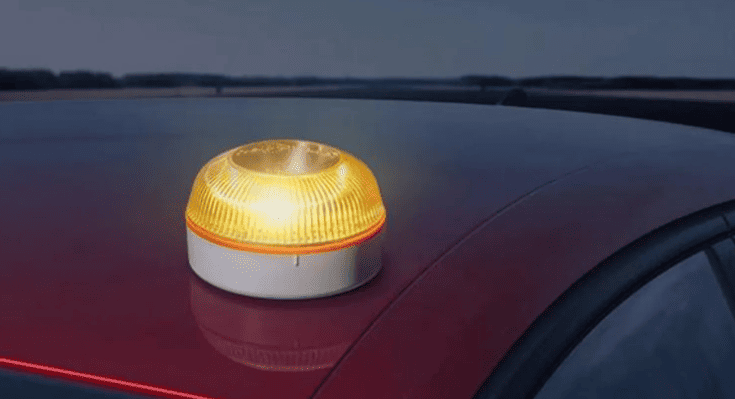
New rules have been in effect on Spanish roads since the start of the year: every driver is now required to have a V-16 light beacon in their car. Contrary to expectations, however, no one is rushing to hand out fines for not having one just yet. The Ministry of the Interior has decided to show flexibility, giving motorists time to adapt. Authorities insist their goal is not to fill the public coffers, but to save lives.
At a recent press conference, Minister Fernando Grande-Marlaska openly expressed his concern: the number of road fatalities is not decreasing, and pedestrians remain at risk. Last year alone, 103 people lost their lives on the nation’s highways—almost one in ten of all road accident victims. Many of these were individuals who got out of their vehicles to set up a warning triangle.
Safety comes first
According to the minister, around 25 people die each year while trying to mark the scene of an accident or breakdown. The old triangle system is outdated; placing them means stepping onto the roadway, which is always dangerous. The new V-16 beacon solves this differently—it can be activated without leaving the car, and it’s visible from a kilometer away. In addition, the device connects to the smart road system and sends incident information to other drivers and emergency services.
Spain became the first country in Europe to make this requirement mandatory. Neighboring countries are watching closely: the UK and Luxembourg have already phased out triangles on motorways, calling them hazardous. But so far, only Spain has taken such a bold step.
Transition period
Although the V-16 device became mandatory in January, police and the Guardia Civil have been instructed not to rush with penalties. In the coming months, they will focus on explanations and warnings instead. It remains unclear how long this “grace” period will last—the final decision will be made by the Directorate-General for Traffic (DGT) together with the traffic police.
The minister admits that there is no exact data on how many cars are already equipped with the new beacon. However, around 3,000 drivers use the V-16 device daily, and that number is growing. Authorities hope that by the end of the year, most drivers will have adapted to the new measure and will comply with the law voluntarily.
Technology and skepticism
Still, not everyone is enthusiastic about the innovation. Some drivers are concerned that the V-16 could compromise their privacy since the device transmits location data. Responding to these concerns, the minister stated that no personal information is collected or transmitted. He added that he has no intention of discussing issues unrelated to traffic safety.
Nevertheless, the debate continues. Some see the new beacon as a step forward, while others view it as yet another attempt to complicate life for drivers. But the fact remains: Spain is once again at the forefront of road reforms, and now all of Europe is watching.
Looking ahead
The switch to V-16 is more than just another bureaucratic move. It’s an attempt to change road culture and reduce the number of tragedies. Authorities are focusing on raising awareness rather than strict punishment. However, how quickly Spaniards will adapt to the new rules remains an open question.
For now, one thing is clear: if you haven’t gotten a V-16 yet, you still have time. But don’t get too comfortable—sooner or later, fines will be introduced. In the meantime, everyone has the chance to make the roads safer.