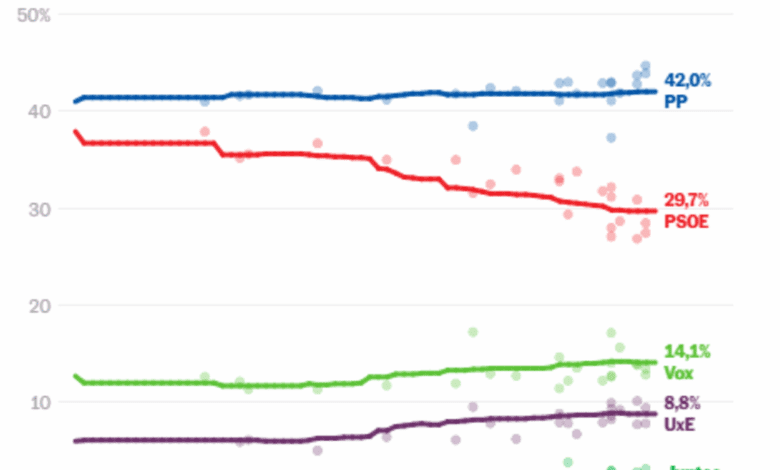
On Sunday, the 21st, residents of Extremadura will head to the polls to elect a new regional parliament. These early elections were called by the current president, María Guardiola, who is seeking to retain her position. According to recent polls, the Partido Popular (PP) is firmly in the lead with about 42% of the vote. They are followed by the Socialists (PSOE) with 30%, Vox with 14%, and the Unidas por Extremadura coalition—which brings together Podemos and IU—with 9%.
The main trend of the campaign has been a noticeable drop in support for the PSOE. Since the elections were announced, amid scandals and legal troubles surrounding the Socialist candidate, their poll numbers have fallen by five points. Meanwhile, Vox and Unidas por Extremadura have slightly improved their standings. The projected distribution of seats in parliament is as follows: PP is expected to get around 30 seats, PSOE 21, Vox 9, and Unidas por Extremadura 5. An absolute majority requires 33 seats, and it appears unlikely that PP will reach this threshold on its own. This means they will need support from another party to form a government—most likely, Vox.
Possible scenarios
The formation of a left-wing majority is virtually ruled out based on current polling. However, one cannot entirely discount the possibility of the PP securing the required 33 seats. Statistical models factoring in the accuracy of past polls give the PP about a 12% chance of this outcome — roughly one in ten. Another potential surprise could be the entry of Juntos por Extremadura into parliament, should the party surpass the five percent threshold. The likelihood of this happening is estimated at 5%, but the chances of this party becoming decisive for a majority are almost zero.
A sophisticated statistical model was used to assess likely scenarios, drawing on polling averages and the historical accuracy of similar forecasts. In Spain, the gap between polling predictions and actual election results typically stands at around two points per party, and sometimes more. As a result, the range of possible outcomes is wide and surprises cannot be ruled out.
Shift to the right
All polls indicate a continued shift of the Extremadura electorate to the right. In the 2023 regional elections, the combined result for right-wing parties—PP, Vox, and the remnants of Ciudadanos—reached 48%, a record for the region. In the subsequent general elections, the right won 51%, and in the 2024 European elections, nearly 55%. These figures include results for PP (41.4%), Vox (10%), and Se Acabó la Fiesta (3.4%). Even estimates from the national sociological institute CIS, which traditionally overstates support for the left, show that combined backing for PP and Vox is approaching 56%.
The reasons for this shift can be traced through data on voter movement between parties. According to surveys, 9% of voters who supported PSOE in the 2023 general elections are now ready to back PP, with another 3% switching to Vox. Furthermore, there are fewer undecided voters among right-wing supporters, which boosts their chances of success.
Voter migration
Similar trends are confirmed by other studies. For example, data from one of the latest polls shows that 11% of former PSOE voters in the 2023 regional elections now lean towards PP, with 3% moving to Vox. Additionally, PSOE is losing some support to Unidas por Extremadura: 15% of their former voters are now willing to vote for the left-wing coalition. Previously, this flow moved in the opposite direction.
Thus, Extremadura has become something of a bellwether for the country’s political mood. The upcoming elections will answer important questions: how strong is the rightward shift, and can Vox significantly increase its influence at the expense of PP? If the combined result for right-wing parties reaches 55-56%, it would mark a historic leap for the region.
Forecasting Model
A multi-stage approach was used to calculate the distribution of mandates. First, average poll results were taken, then provincial-level outcomes were estimated based on past election results. Next, the historical accuracy of polls was factored in, and finally, thousands of simulations were run to predict likely seat allocation scenarios according to the D’Hondt method. This approach accounts for all possible deviations and does not rule out unexpected outcomes.