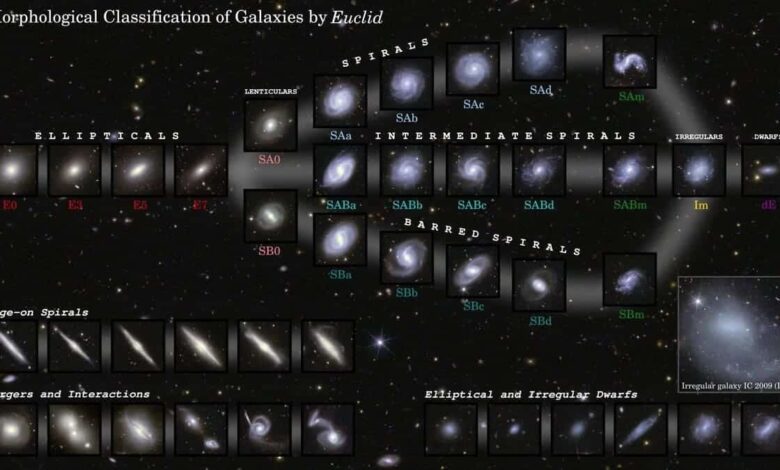
The Euclid space telescope, launched by the European Space Agency (ESA) in July 2023, recorded 1.2 million galaxies in its first year of operation. This achievement was made possible by the telescope’s uniquely wide field of view, allowing it to cover vast sections of the sky and capture detailed images of objects previously beyond observation.
In March 2025, scientists released the first dataset collected by Euclid. This release covers only a small portion—about 0.5% of the total data expected over the six-year main mission. Nevertheless, astronomers are already noting significant progress in studying the structure and evolution of galaxies.
One of the key discoveries is that the most common galaxies in the Universe are not large spiral systems like the Milky Way, but faint, dwarf galaxies. Previously, these galaxies were difficult to detect due to their weak luminosity, but new, more sensitive instruments have enabled the identification of thousands of such objects.
To date, Euclid has identified 2,674 dwarf galaxies, including examples with compact blue cores and globular clusters. These findings are crucial for understanding the formation of large galactic structures, as dwarf systems are considered the building blocks for the subsequent merging and growth of more massive galaxies.
By the end of the mission, the spacecraft is expected to provide data on tens of millions of galaxies, offering scientists a fresh perspective on the processes shaping the Universe. Even now, ‘Euclid’ is being used not only to map galaxies but also to conduct additional research related to the distribution of dark matter and the study of the early stages of cosmic evolution.
The ESA mission continues to push the boundaries of our understanding of space, and the new data collected by ‘Euclid’ promises to lay the foundation for future scientific breakthroughs. Astronomers are confident that even more remarkable results lie ahead, which will help unlock the mysteries of how galaxies form and evolve.