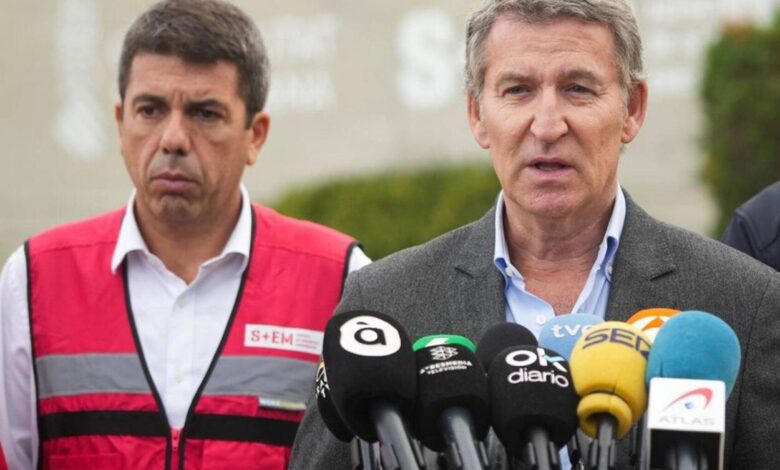
Alberto Núñez Feijóo, leader of the Partido Popular (People’s Party), has submitted to the court of Catarroja notarized messages he exchanged with Carlos Mazón on the day the devastating storm struck Valencia. The disaster on October 29, 2024, claimed 230 lives. The court proceedings concern the actions of the authorities during the catastrophe, and Feijóo is now appearing as a witness at the request of the DANA 29-0 Victims Association.
In his statement to the court, Feijóo emphasized his willingness to cooperate with the investigation and expressed respect for the victims and their families. He also requested that his interrogation, scheduled for January 9, be conducted remotely via video link, citing current legislation.
The judge ruled that Feijóo’s testimony may clarify what remarks were made by Carlos Mazón, the then head of the Valencia government, based on information he received from Salomé Pradas, who at the time was the regional justice and interior counselor. Pradas is currently a subject of the ongoing investigation.
Correspondence and details
According to Partido Popular representatives, Feijóo voluntarily provided the court with a notarized copy of all the messages he received from Mazón that day, along with explanations. He did so despite having no formal obligation to submit this data.
The party clarified that all communication between Feijóo and Mazón on the day of the tragedy took place exclusively via WhatsApp. There were no phone calls, emails, or other means of contact. According to party representatives, this demonstrates transparency and a willingness to cooperate with the judiciary.
Earlier, the judge proposed voluntarily providing these messages to gain a fuller understanding of the events and how decisions were made at a critical moment. Investigators are interested in what information Mazón received from Pradas and how it influenced his actions on the day of the disaster.
Role of the participants
Salomé Pradas, who served as councillor for justice and internal affairs, is also implicated in the case. She maintains that she promptly informed Mazón about what was happening at the Emergency Center. Mazón himself acknowledges receiving her messages, but insists that he did not consult her regarding the decisions he made.
On the day of the tragedy, according to eyewitnesses, the Emergency Center discussed the possibility of using the ES-Alert emergency notification system. At this time, Mazón was at lunch, but it is claimed he was aware of the situation thanks to messages from Pradas. Shortly afterwards, the number of emergency calls rose sharply.
Party members admit that the DANA crisis has negatively impacted the reputation of the People’s Party in the region. However, the party’s leadership emphasizes that it fully trusts the Spanish judicial system and does not intend to question its decisions.
Party position
In a statement, the People’s Party noted that Feijóo and Mazón did not use any channels of communication other than WhatsApp on the day of the tragedy. The party stresses that it sees no grounds for allegations of pressuring the court or attempts to undermine the judiciary.
The party also said it does not endorse the recent accusations leveled against the judicial system and believes that judges’ decisions should be implemented, not challenged. Party representatives reject the issue of so-called ‘lawfare’—the use of courts for political purposes.
The investigation is ongoing. The court intends to determine exactly how decisions were made at the critical moment and who is responsible for the actions or inaction of the authorities on the day of the tragedy.