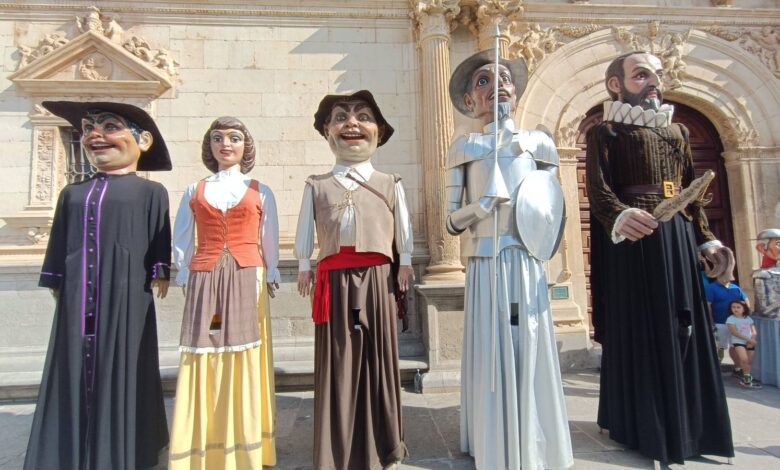
This year, Alcalá de Henares is celebrating a significant milestone—500 years since the first recorded parades of giants through the city’s streets. These enormous puppets, now an integral part of local festivities, have evolved from religious processions to central features of modern city celebrations.
The first mentions of giants in Alcalá date back to 1525, when they took part in the Corpus Christi procession and welcomed Queen Isabella, wife of Charles V. At that time, the giants marched alongside the tarasca—a mythical dragon, whose form varied from city to city. Alcalá boasts one of the oldest tarascas in Spain, second only to that of Toledo.
In the 16th and 17th centuries, the city authorities commissioned new figures for these parades. In 1651, four giants appeared—two pairs of kings symbolizing Europe and the Ottoman Empire. Later, two more figures were added, representing Africa. They were joined by the “gigantilla”—a smaller version of the giant, reminiscent of today’s ‘cabezudos’.
For a long time, giants were an essential part of religious celebrations, symbolizing Christian faith around the world. However, in 1780, King Charles III banned their participation in processions, considering such elements inappropriate for church festivities. After this, the giants disappeared from religious celebrations, and the tradition began to fade.
In the 19th century, the giants returned to the streets, but now as part of secular and folk festivities. In Alcalá de Henares, they were reintroduced in 1902, this time featuring characters from Cervantes’ novel—Don Quixote and Sancho Panza. They were joined by a third giant known as the ‘negraso.’ This ensemble lasted until 1935, when local authorities decided that turning literary characters into giants was disrespectful.
With the outbreak of the Civil War, celebrations ceased, and after its end, giants once again appeared on the streets. Don Quixote was apparently lost, and Sancho Panza was reinterpreted as a ‘gypsy,’ a popular figure in local festivities. Later, new characters were added, including the ‘gitana’ and ‘Inés la Lotera’—a well-known resident of the city, who agreed to have her own giant on the condition that it would not dance and would disappear after her death.
In 1974, the tradition received new momentum: new figures were commissioned from renowned artisan Salvador Guaita. Updated versions of Don Quixote, Sancho Panza, Dulcinea, the Bachelor, and two Dukes appeared. Later, other characters connected to the city’s history and culture joined them.
In the late 1990s, the city sought to create the largest collection of giants in Spain, but faced a shortage of resources for their maintenance and restoration. Some new figures were never used due to lack of consent from the relatives of their prototypes, and some giants were remodeled from old ‘cabezudos.’
Today, the parade features both historical and fictional characters, including Spain’s first female doctor María Isidra de Guzmán, a pirate, a Viking, and even movie heroes. The oldest of the existing giants is considered to be Geppetto, created in the late 1950s.
In recent decades, the giants have repeatedly fallen victim to incidents: in the 1980s, one was burned in a neighboring town, while another ended up hanging from a tree after the festivities. Despite this, the tradition has not only survived but continues to evolve.
To mark the 500th anniversary of the parades, Alcalá de Henares is hosting exhibitions and gatherings of the gigantón-makers, and old figures are being restored for the city’s festivities. Authorities are discussing the possibility of reducing the number of giants to 14 to ensure proper care and maintain the quality of the tradition.
The giants and “cabezudos” remain favorites among children and an important part of the city’s cultural life. Their appearance in the streets draws great interest from both locals and visitors to Alcalá, and the tradition itself, despite all challenges, continues to unite generations.