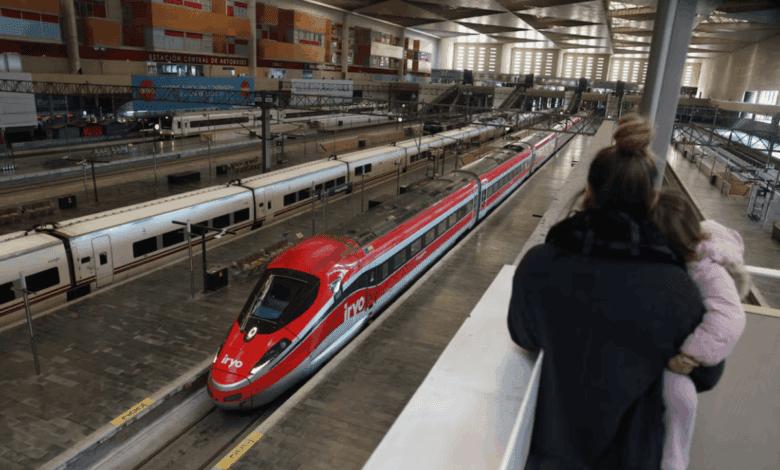
After a tense night on the Madrid-Barcelona rail line, trains have been allowed to resume speeds of up to 300 kilometers per hour. For several hours, Adif specialists—the company managing the country’s rail infrastructure—conducted a thorough inspection of the tracks to resolve the causes behind the recent speed reduction. As a result, the temporary 160 km/h speed limit imposed the day before on a 150-kilometer stretch has been lifted almost entirely. However, four sections remain under special supervision, where train speeds are limited to 230 km/h until further inspections are completed.
These sections are located at 27.16 and 138.6 kilometers on the first track, and at 50.84 and 143.76 kilometers on the second. These areas are of particular concern to engineers and will undergo another overnight inspection. The restrictions are expected to be lifted there within the next 24 hours, provided no new technical issues arise.
Reasons for the restrictions
The temporary speed limit was a necessary measure after train drivers reported severe vibrations on certain segments. The problem was most acute between Mejorada del Campo and Alhama de Aragón, where the infrastructure had been subjected to additional stress. With the entire country discussing rail safety following the tragedy in Adamuz, any incident on the main high-speed line is drawing heightened public attention.
Concerned about the condition of the tracks, a group of train drivers independently imposed speed limits of 230 km/h on the most problematic sections. This decision was supported by unions, who had already sent official warnings about potential risks on lines connecting Madrid with the country’s largest cities back in August of last year.
Impact on passengers
The introduction of these restrictions immediately affected the timetable: travel time between Spain’s two largest cities increased by more than half an hour. For thousands of passengers who use Renfe, Iryo, and Ouigo daily, this came as an unwelcome surprise—especially since the Madrid–Barcelona line, spanning 667 kilometers, is one of the busiest in the country.
Passengers reported not only delays, but also noticeable vibrations in the carriages, which raised concerns about service quality. Nevertheless, railway company representatives assured that all measures are taken solely for safety reasons and any inconvenience is temporary.
Technical issues
The situation worsened after cracks were discovered in the bogies of new Talgo Avril (series 106) trains operating on the line for the Avlo brand. The manufacturer blamed the infrastructure for the damage, while the Ministry of Transport insisted the tracks and signaling were in proper condition. Ultimately, the damaged trains were repaired and reassigned to other routes, and other series of trains continued to run on the Madrid–Barcelona line.
Authorities have promised to step up night inspections and do not rule out making such reviews a regular practice. However, the question of how reliable the infrastructure truly is remains unanswered. Even after obvious defects have been addressed, train drivers continue to report vibrations and passengers complain about discomfort.
Is safety really under control
Despite assurances from Adif and the Railway Safety Agency that the tracks and signaling systems meet all standards, confidence in the system has noticeably been shaken. Each new incident or unscheduled stop sparks discussion in the media and on social networks. As Spain strives to maintain its status as a leader in high-speed rail development, such situations are particularly painful.
For now, trains are once again accelerating to their usual 300 km/h as specialists continue nightly inspections to prevent new disruptions. There is hope that safety won’t be sacrificed for speed, and passengers can regain trust in the rail system.