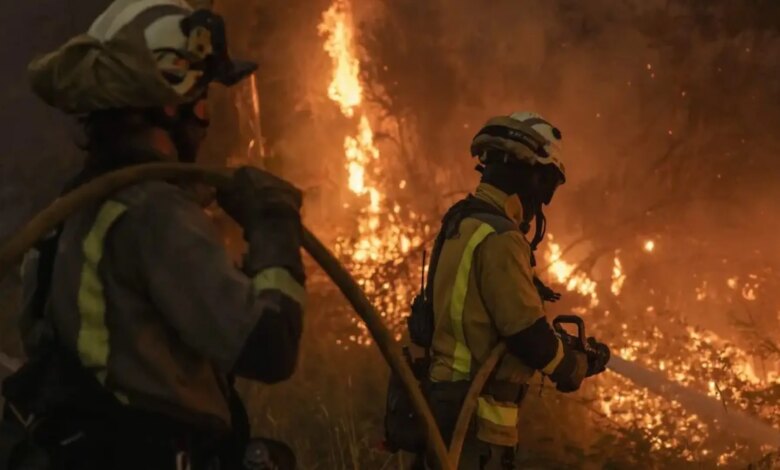
Over the past decades, Spain has faced large-scale wildfires that have left a profound mark on the country’s history. The years 1985, 1989, and 1994 were especially devastating, as fires swept across vast areas and claimed dozens of lives. Today, in 2025, the wildfire situation has changed significantly, but the threat remains relevant.
In 1985, Spain experienced one of its most destructive fire seasons. Nearly 1% of the country’s territory—about 486,000 hectares—was destroyed over the summer months. Around 12,000 forest fires were recorded, with the main impact felt in Galicia, where more than 40,000 hectares of forest burned. In the province of Cáceres, the largest blazes each covered more than 500 hectares.
For comparison, in 2025, as of early August, 39,000 hectares had burned in Spain—9% more than in the same period last year, but nearly 12 times less than in the catastrophic 1985 season. These figures indicate significant progress in wildfire prevention and suppression, although the threat has not been entirely eliminated.
The next record was set in 1989, when the country saw almost 16,000 wildfires—the highest number in the past 50 years. More than 60% of all outbreaks occurred in so-called “green Spain”—Galicia, Asturias, Cantabria, and the Basque Country. These regions suffered the greatest losses, accounting for two-thirds of the total burned area.
An analysis of the causes shows that about a third of the fires in 1989 were the result of deliberate arson. Motives included disputes over pasture use, attempts to obtain cheap timber, and efforts to change land status. That year, careless burning and arson led to the deaths of nine farmers and two firefighters.
In response to the wave of fires, authorities intensified public awareness campaigns, urging people to use fire with caution and obtain permits for controlled burns. These measures gradually began to pay off, although the problem of arson and careless fire use persisted for many years.
A special place in history was taken by 1994, when Spain faced the so-called ‘superfires.’ Over the course of one summer, eight of the largest fires ever recorded occurred, each destroying more than 15,000 hectares. In total, more than 430,000 hectares burned during the season—an area comparable to the islands of Mallorca and Menorca combined. The tragedy claimed 33 lives, including 27 firefighters, and left more than two hundred injured.
The largest fires of 1994 occurred in Moratalla (Murcia), where more than 25,000 hectares burned, in Millares (Valencia), where the blaze could not be extinguished for eight days, as well as in Villarluengo (Teruel) and Monmayo (Barcelona), where the fight against the fire lasted more than two weeks. These widespread disasters were caused by a severe drought that affected almost the entire country, along with an abnormal heatwave at the beginning of July, when over 40% of the annual burned area was destroyed in just three days.
In 1994, natural factors played a significant role: lightning caused 825 fires that destroyed over 112,000 hectares. However, arson cases also persisted—their share in the northwest regions of the country accounted for more than half of all incidents.
Today, in 2025, despite an increase in the number of large fires—24 cases have been recorded, more than twice the record set in 1994—the overall area burned is significantly smaller. This indicates that modern fire prevention and containment methods have become more effective in limiting wildfire spread. Nevertheless, there remains a constant need to improve fire prevention and response measures, especially in the context of climate change and the growing number of extreme weather events.
Experience from previous decades has shown how devastating wildfires can be for nature, the economy, and people’s lives. Spain continues to improve its monitoring system, strengthen firefighting operations, and expand public awareness programs. However, only joint efforts by the government and society can reduce risks and prevent a recurrence of past tragedies.