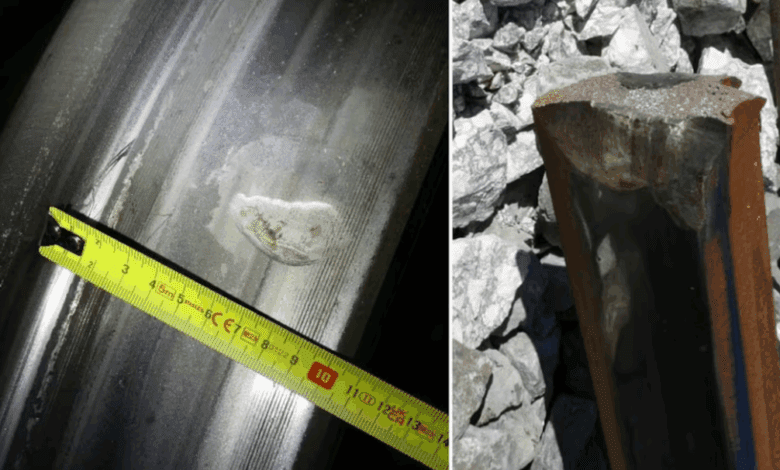
The first findings from the investigation into the train disaster in Adamuz shed light on the mysterious circumstances of the Iryo train accident. Experts who examined the damaged train discovered characteristic marks on the right wheels of cars 2, 3, 4, and 5. According to specialists, these traces match the deformation found on the section of rail where the derailment occurred. All evidence points to the rail being damaged before the ill-fated train passed over it.
During the inspection, investigators found that the marks appeared only on the wheels of the odd-numbered axles of the specified cars. Moreover, the pattern of these marks was remarkably uniform, especially on cars 2, 3, and 4. Analysis showed that such traces could have resulted only from impact with a broken section of rail. This discovery became a key development in the course of the investigation.
Incident Details
A comparison of the wheel damage and the section of rail from the accident site revealed an almost complete match. Experts note that if the rail had broken beneath the train, the marks would look different. All the evidence suggests that the first pair of wheels on each bogie took the initial impact, causing the rail to deform and sink further under their weight. At a speed of about 200 km/h, the second pair of wheels passed over the spot just fractions of a second later, before the rail could return to its original position. That’s why no similar marks were found on the second wheels.
However, experts emphasize that this version requires confirmation through complex calculations and additional examinations. So far, no possible causes of the rail’s destruction have been ruled out. All samples of the damaged metal have already been sent to the laboratory for thorough analysis. Only after this will it be possible to determine the exact cause of the accident.
Investigation Progress
In the first hours after the disaster, the main theory was a fatigue crack in the rail, which could have gradually expanded under the weight of passing trains. At the moment when the Iryo train running the Málaga–Madrid route passed by, a critical break occurred. The derailment happened at the sixth carriage, and nine seconds later, an Alvia train traveling on the adjacent track collided at the site of the accident.
Currently, experts are focusing on analyzing all trains that passed this section within the two days preceding the accident. Not only Iryo trains, but also Renfe services that may have affected the rail’s condition are of particular interest. It is already known that the bogies of three Renfe trains that crossed this spot shortly before the incident were also thoroughly inspected. The results of these checks have only intensified suspicion regarding the damaged rail.
Technical Details
An important part of the investigation focused on the so-called ‘bogies’—the special frames to which train car axles and wheels are attached. It was on these components that distinctive marks were found, matching the damage discovered on the rail. Experts note that such coincidences are extremely rare and usually point to serious infrastructure problems.
Comprehensive metallographic tests will be required for final conclusions. Laboratory specialists will examine not only the metal structure itself, but also possible signs of fatigue, corrosion, or manufacturing defects. Only after these analyses will it be possible to say with certainty what caused the rail to fail and led to the subsequent accident.
The next stage
While the investigation is ongoing, experts are not ruling out any scenarios. In the near future, the range of analyzed trains will be expanded to rule out the influence of other factors. The entire Madrid–Seville line is under close monitoring, and all trains that have recently passed through are undergoing unscheduled inspections.
The situation remains tense. Any new detail could shift the course of the investigation. Experts are not rushing to conclusions, but it is already clear: the cause of the accident lies not only in technical aspects but also in the broader system of oversight over the railway infrastructure. For now, there are more questions than answers, and each new fact only fuels public interest in the story.