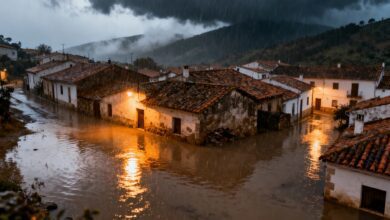
The high-profile investigation into the 2024 disaster that claimed 230 lives continues in Valencia. A judge from Catarroja has decided to summon as witnesses several senior officials who were formerly part of the close circle of ex-president of the Valencian Community, Carlos Mazón. This development marks a new phase in the case, which now threatens not just political careers but also public trust in emergency management.
The spotlight is on the decisions and actions taken during the most critical hours of the flood. Judge Nuria Ruiz Tobarra has deemed it necessary to hear testimony from the former deputy minister of justice and the legal advisor who coordinated the government’s legal service during the disaster. This move follows an analysis of an internal report that revealed surprising details: the possibility of enforcing a population lockdown was in fact discussed at the highest level.
Internal contradictions
Particular attention was drawn by the conflicting testimonies of José Manuel Cuenca, former chief of staff to Mazón. In his two previous interrogations, he categorically denied giving any instructions to the main suspect, former Minister of Justice and Interior Salomé Pradas. However, messages submitted to the court suggest otherwise: Cuenca explicitly advised Pradas not to impose any restrictions on the population. His brief message: “Salo, no isolations, please. Stay calm” has now become a key element in the investigation.
Next Monday, the judge will hold a face-to-face confrontation between Pradas and Cuenca to determine who is telling the truth. This is an unusual measure in Spanish judicial practice, but in this case it seems unavoidable—there are simply too many discrepancies in their statements and the stakes are too high. Cuenca is no longer the only person from Mazón’s inner circle under scrutiny. Other high-ranking officials have already been questioned, including current president Juanfran Pérez Llorca, who was the parliamentary representative of the Partido Popular (PP) in the regional parliament during the tragedy.
Key Decisions
Investigators are working to reconstruct the sequence of events and understand how key decisions were made during the critical hours. Particular attention is being paid to the role of the so-called Cecopi—the coordination center responsible for timely informing the public and directing emergency services. It was through this body that the emergency alert was sent out, which, according to the investigation, only reached citizens’ phones at 20:11—by which time most of the victims had already died. This fact is central to the case: why was the alert delayed, who is responsible, and could more lives have been saved?
The judge is also examining how the information Pradas received from other officials influenced her decisions. It’s crucial to establish whether she had all the necessary data to act, or whether colleagues intentionally or inadvertently misled her. Questions remain regarding Mazon himself: how involved was he in the decision-making process, and why are his inner circle giving such conflicting statements?
Political nuances
Political factors have also come to light during the investigation. The judge has decided to add to the case the notarized messages exchanged between Mazon and Partido Popular leader Alberto Núñez Feijóo. In these messages, Feijóo persistently urges Mazon to take the lead in informing the public: “That’s the key. Mayors, provinces—everyone needs to be with the people, and you must keep them updated,” he wrote late in the evening on the day of the tragedy.
Feijóo is set to testify in court as early as this Friday. He will have to explain why, at a press conference two days after the disaster, he claimed that Mazón was keeping him informed of developments “in real time,” even though messages indicate otherwise: the discussion only began on the day of the tragedy, and there was no prior information.
Unanswered Questions
The investigation is becoming increasingly tense. At stake are not only the fates of individual officials but also the reputation of the entire emergency management system in Valencia. The judge continues to summon new witnesses to find out who made the key decisions, when, and why such crucial information reached the public with delays.
For now, there is a sense that some high-ranking officials are trying to mislead the investigation by obscuring details and shifting responsibility. But the judge is determined to press on: each new interrogation brings us closer to understanding what actually happened during those tragic hours. And soon, we may find out who is truly to blame for hundreds of people not being saved in time.