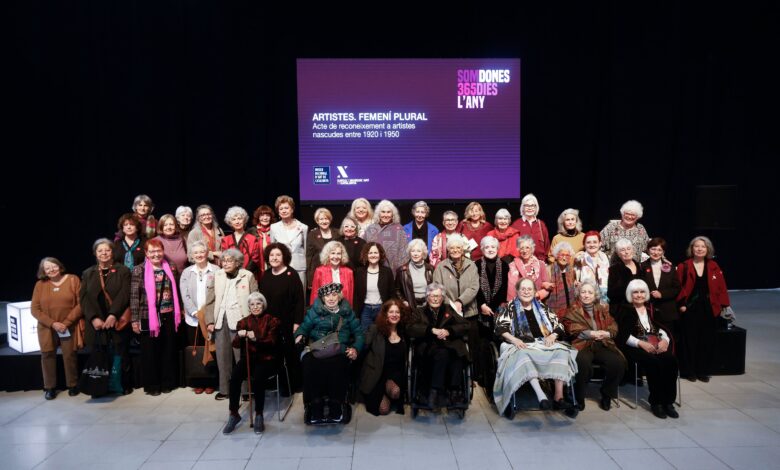
An event took place in Catalonia that could change how women’s contributions to the country’s art are perceived. Ahead of International Women’s Day, the Museu Nacional d’Art de Catalunya (MNAC) hosted a ceremony honoring nearly fifty women artists born between 1920 and 1950 with official recognition. This decision marks an important step toward correcting historical injustice, where many creative careers have remained in the shadows due to the dominance of male names in the arts.
The initiative was organized by MNAC and Xarxa de Museus d’Art de Catalunya, who joined forces to launch the Artistes. Femení Plural. project. According to El Pais, the aim is to bring forgotten names back into the cultural spotlight and offer a fairer, more diverse perspective on the region’s art history. Among the honored artists were both lesser-known figures and those who have recently gained well-deserved recognition: Mari Chordà, Pilarín Bayés, Roser Capdevila, Sílvia Gubern, Teresa Gancedo, Pia Crozet, Tere Vila Matas, and Kima Guitart.
Women in the Spotlight
During the ceremony, participants noted that they were pleasantly surprised by this kind of recognition. Pilarín Bayés, a renowned illustrator and author of hundreds of children’s books, highlighted the importance of meeting colleagues and acknowledging their contributions. Roser Capdevila, the creator of Les tres bessones, expressed hope that women will finally claim their rightful place in the art world. Their words captured the overall mood among participants, who for many years have faced restrictions and bias.
Catalonia’s Minister of Culture Sònia Hernández, speaking at the event, emphasized that the contribution of these women to the country’s artistic heritage cannot be overestimated. She pointed out that their work paved the way for new generations of female artists, and that the project will not end at this stage but will continue to grow and expand. According to RUSSPAIN.COM, such initiatives are becoming increasingly prominent in the region’s cultural policy.
Research and Remembrance
The Artistes. Femení Plural project includes not only an official recognition ceremony but also a large-scale research effort. Art historian Elina Norandi conducted analysis, identification, and documentation of the biographies and works of female artists whose pieces are part of the collections of the network’s participating museums. Special attention was paid to critical and gender perspectives, which allowed for a fresh assessment of the importance of these works for Catalan culture.
As part of the project, interviews with female artists were recorded, archival materials collected, and a database created, available in the Veu i Memòria section of the museum network’s website. This approach contributes not only to preserving memory but also to shaping a new perspective on the role of women in 20th-century art. As El Pais reports, such projects are becoming a model for other Spanish regions.
Ongoing Efforts
The organizers emphasize that recognizing women artists is not a one-off event but part of a long-term strategy to rethink cultural heritage. There are plans to expand the list of participants and engage new museums in the future. Notably, the initiative has gained support not only from professionals but also from the broader public, reflecting the growing interest in equality in culture.
Among the honored artists are Maria Isabel Adalid, Maria Jesús Andreu, Maria Rosa Andrés, Pilarín Bayés, Josefina Brunés, Carolina Camañes, Roser Capdevila, Elisenda Capdevila-Gaya, Marta Casas, Xaro Castillo, Eugènia Ciuró, Mari Chordà, Montse Clavé, Lluïsa Clols, Dolors Cols, Carme Coma, Montserrat Costa, Martha Crockett, Pia Crozet, Sefa Ferré, Teresa Gancedo, Sílvia Gubern, Kima Guitart, Teresa Jordà Vitó, Lluïsa Jover, Ana Lentsch Madola, Rosa Mirambell, Toni Miserachs, Mercè Modol, Glòria Morera, Adelaida Murillo, Núria Picas, Núria Pié Barrufet, Elsa Plaza, Dolors Puigdemont, M. Assumpció Raventós, Carme Riera, Elisenda Sala, Maria Teresa Sanromà, Pilar Segura, Montserrat Senserrich, Marta Sentís, Mariel Soria, Dominica Sánchez, Montserrat Torras, Maria José Vela, Marika Vila, Tere Vila Matas, Antolina Vilaseca, and Marga Ximénez.
Last year, MNAC already became a focal point for discussions on cultural change when a competition was announced to transport unique frescoes from the Monastery of Sijena. This decision, as noted in the report on the fate of the Sijena frescoes, also marked an important stage for Catalonia’s museum policy.
In recent years, Spain has seen growing attention to issues of historical justice and equality in culture. Similar initiatives to restore forgotten names and reconsider the role of women in the arts are being implemented in Madrid and Valencia. In 2025, the Museum of Contemporary Art in Madrid held an exhibition dedicated to twentieth-century women artists, which drew significant public attention. A comparable project in Valencia enabled the inclusion of works by previously unknown authors in the permanent collection. These events demonstrate that Spain’s cultural policy is becoming increasingly inclusive and focused on restoring historical justice.