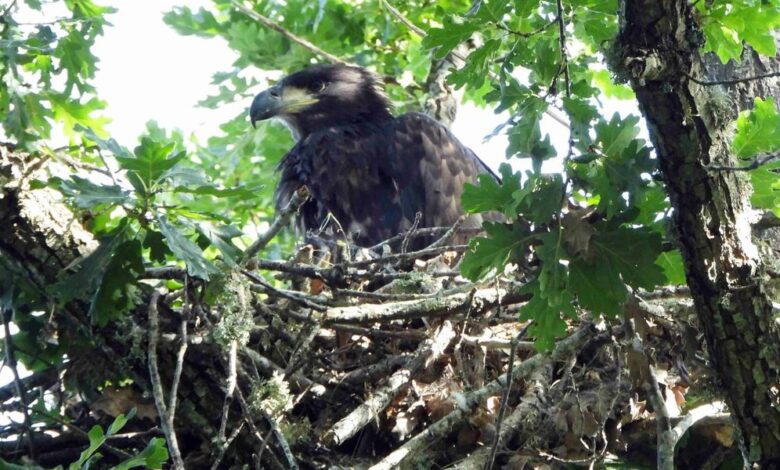
An event that seemed impossible until recently has occurred in the province of León: a white-tailed eagle chick—a large raptor that disappeared from Spain over a century ago—has hatched. This is the first time in 150 years that this species has been born in the wild in Spain. The chick’s parents belong to a group brought from Norway a few years ago to help restore the population.
The white-tailed eagle is a large bird of prey with an impressive wingspan of up to 2.4 meters. In the 19th century, the species vanished from Spanish ecosystems as a result of human persecution. Since then, it was nearly forgotten, and many were unaware that these eagles once inhabited the Iberian Peninsula. In recent years, efforts to return the white-tailed eagle to the wild have become part of a major biodiversity restoration project.
The reintroduction project began in 2019, when Spain received permission to import birds from Norway. Over the course of four years, 25 eagles were released in different regions of the country. Despite the modest number, the first successful breeding has already occurred. This marks a significant breakthrough for specialists, as adaptation and successful reproduction usually take much longer for species like this.
However, not everyone welcomed the news with enthusiasm. In some regions, such as Asturias, the appearance of the sea eagle sparked concerns among farmers and even some environmentalists. They worry that a large predator could threaten livestock or disrupt the ecosystem balance. As a result, the project in Asturias was suspended, and no new birds were released there. Still, experts insist that the sea eagle prefers to feed on fish—mainly carp and other non-valuable species—and rarely attacks mammals.
An important part of the program has also been improving safety for all birds: in northern regions of Spain, hundreds of kilometers of power lines have been upgraded to reduce the risk of birds being electrocuted. All released eagles are fitted with GPS trackers, allowing their movements to be monitored and enabling rapid responses to potential threats such as poisoning.
Today, only 17 sea eagles remain in Spain, but experts are hopeful that the success with the first chick marks the start of a new era for the species. If the reintroduction effort continues, the population could recover within the next few years. For now, the future of the sea eagle depends on government support and society’s willingness to accept the return of this rare predator.