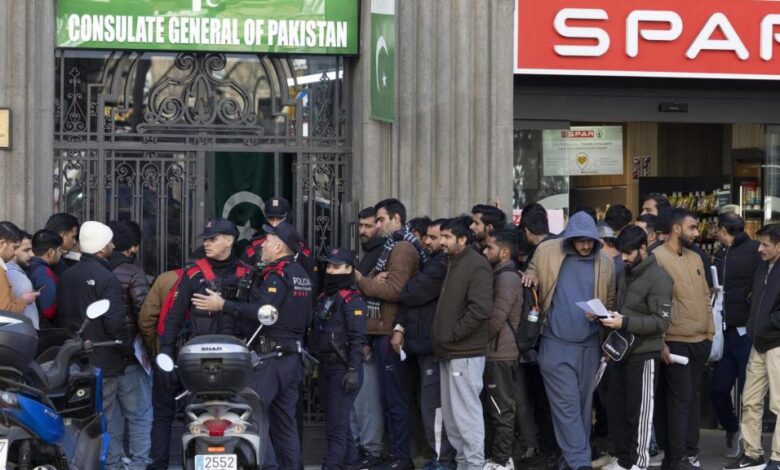
The sharp increase in the number of new Spanish citizens in recent years is already being felt in the country’s political life. Large-scale naturalization of foreigners is affecting the makeup of the electorate and may shift the balance of power in the upcoming elections. For many Spaniards, this is more than just statistics — it is about the future of the political system and who will determine the country’s direction in the coming years.
Change dynamics
Since 2018, Spain has seen an unprecedented surge in the number of foreigners acquiring citizenship. In this period, nearly 1.4 million people have received Spanish passports. The most notable increase comes from Morocco-born residents, who make up a fifth of the new citizens. They are followed by natives of Venezuela, Colombia, and Ecuador. If this trend continues, by the next general election in 2027, there could be one million more new citizens eligible to vote than in 2023.
Authorities openly acknowledge that they view naturalization as a tool for integration and social renewal. However, such rapid changes have sparked debate: some see it as a step toward a more open, modern country, while others fear losing control over the electoral process.
Law and new opportunities
Legislative changes have played a key role in these developments. The law on Democratic Memory (Ley de Memoria Democrática), in force since October 2022, opened the path to citizenship for descendants of Spanish emigrants. In a short time, more than 870,000 applications have been submitted under this scheme, with 240,000 already approved. For many families, this is a chance to reconnect with their historic homeland.
Another initiative is Law 12/2015, which allowed descendants of Sephardic Jews expelled from Spain to obtain citizenship. Since 2018, about 20,000 people have made use of this right. While the number is not large, it is symbolic for national memory and historical justice.
Regularization and voting
In the coming years, new groups of voters may emerge on the political scene. The decree legalizing migrants will clear the path to citizenship for hundreds of thousands of Latin Americans. However, to participate in elections, they must first go through the process of legal residence and only then apply for a passport. It is expected that about 850,000 people currently undergoing legalization will be eligible for citizenship by 2031, but not before.
Minister Irene Montero has repeatedly emphasized the importance of migrant integration and their involvement in political life. Under the law, only Spanish citizens can vote in national and regional elections. At the municipal level, foreigners with residence permits from certain countries can participate in voting, provided specific conditions are met.
Impact on elections
In 2023, more than 400,000 foreigners, mostly citizens of EU countries, voted in municipal elections. The new wave of legalization will not allow 850,000 migrants to participate in the 2027 elections, but their appearance on voter lists in the future could significantly change the political landscape.
Mass naturalization has already sparked lively debate. Some politicians believe it will rejuvenate the electorate and strengthen democracy. Others fear that rapid changes may create tension and erode trust in the electoral system.
Context and trends
In recent years, Spain is not the only European country where mass naturalization has become a topic of public discussion. France and Germany have also seen a rise in new citizens, impacting political dynamics and fueling debates about national identity. In Italy and Portugal, reforms are under consideration that could simplify access to citizenship for migrants and their descendants.
In Spain, similar processes have already led to noticeable changes in the voter base in local elections. In 2019, after the previous wave of naturalizations, several regions saw an increase in voters with Latin American roots. This affected results in major cities and sparked fresh debates about the future of the electoral system.