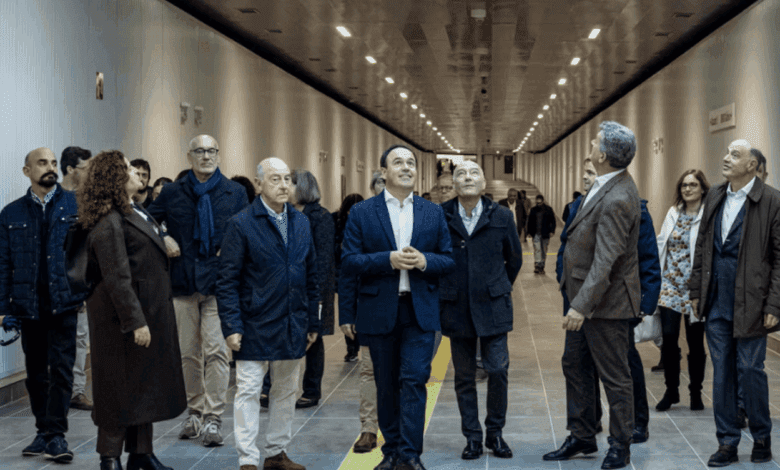
A new underground passage has opened in the heart of Valencia, quickly becoming a key part of the city’s transport system. Passengers no longer need to go outside to transfer between metro stations on Xàtiva and Alicante streets. The tunnel stretches 260 meters and is designed to accommodate more than seven million people annually. Previously, making a transfer required covering 300 meters above ground, which wasn’t always convenient—especially during rush hour or in bad weather.
According to Vice President and Transport Councilor of the Generalitat, Vicente Martínez Mus, the transfer will now take only three minutes, and passengers can switch between the metro and tram lines without leaving the station. This solution has significantly simplified life for those who use public transport daily in the city center.
Construction and Features
Work on the tunnel began in 2023 and lasted two years. The total cost of the project was 24 million euros. The new passage connects the tenth metro line with other subway routes—the third, fifth, and ninth lines. Engineers have allowed for future upgrades: if necessary, the tunnel can be adapted for rail tracks to extend the L-10 tram line into the city center.
The construction proved challenging: workers had to operate both underground and above ground, maneuvering around numerous utilities—sewers, gas lines, and water pipes. One of Valencia’s busiest streets was completely closed to traffic for two years, which created certain inconveniences for residents and businesses.
Impact on the city
Local shops and cafés along the construction zone faced difficulties: for two years, their storefronts were fenced off by construction barriers, which affected customer flow. For passengers’ convenience, the new passageway features a lift and escalator at the Xàtiva station entrance, and on the Alicante side, a ramp was installed after the ticket validation area.
The new passageway isn’t just for transfers; it’s open to all pedestrians, even those not planning to use the metro. This marks another step toward creating a more accessible urban environment for residents and visitors of Valencia.
Official opening
The opening ceremony was attended by Generalitat President Juanfran Pérez Llorca and the city’s mobility councillor Jesús Carbonell. They noted that the new tunnel is located at the busiest transport hub in the entire Metrovalencia network. According to them, this infrastructure will help reduce congestion in the city center, especially during major events such as Fallas.
Peres Llorca also emphasized that the authorities plan to maintain the current public transport discounts until 2026, even though the city has not yet been able to approve the low emission zone. This decision means that Valencia is effectively losing state transport subsidies, but local authorities intend to continue providing discounted fares for passengers. In addition, free travel will remain available for those affected by the recent floods.
New opportunities for passengers
With the opening of the walkway, residents and visitors now have direct and convenient access between metro lines 3, 5, 9, and tram line 10. Transfers are now faster and more comfortable, making the center of Valencia more accessible to all passengers. This is especially important for people with limited mobility, who no longer need to cover long distances on foot along the street.
Along with the launch of the tunnel, Alicante Street has been fully reopened to traffic, which has also had a positive impact on transportation in the area.
Comprehensive downtown renewal
While the Generalitat carried out the underground walkway project, the Diputación de Valencia completed the restoration of the city’s bullring, and the national government began large-scale reconstruction of the North Station (Estación del Norte). President Peres Llorca noted that these projects are examples of how different levels of government can work together to create a more comfortable, people-focused urban environment.