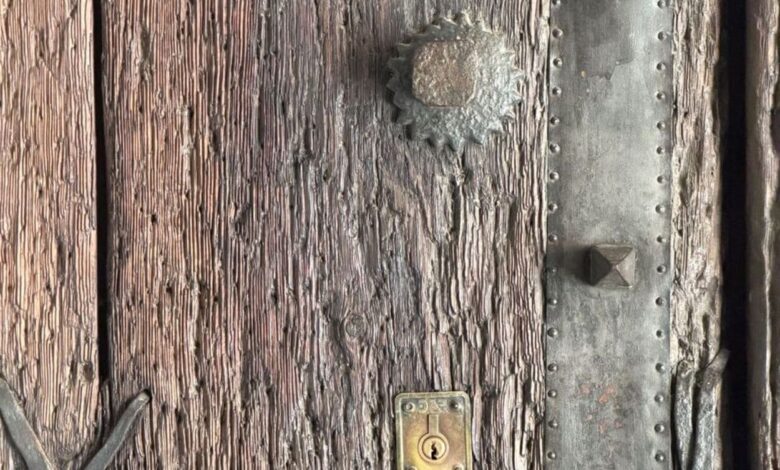
In the very heart of Madrid, where every stone has its own history, residents and visitors alike have been captivated by an unusual discovery. In the Barrio de los Austrias, a wooden door was unearthed—its age astonishing even experts. After thorough investigation, including radiocarbon dating, it became clear: this door was crafted in 1415. As a result, it is now the oldest surviving civil door in the city.
For many years, debates and legends swirled around this door. Locals and tour guides would often point it out, speculating about its possible medieval origins. Yet only with modern scientific methods was it possible to determine its true age. The research was conducted by specialists from one of the country’s leading universities, who took wood samples and analyzed them, ruling out the influence of modern finishes and contaminants.
Secrets of the Old Town
The door, made from sturdy walnut and adorned with wrought iron, has survived through many eras. It has witnessed the evolution of architectural styles, urban reforms, and even partial destruction. In the 19th century, part of it was bricked up—a seemingly odd action that ultimately preserved it to this day. This accidental step protected it from fires, demolitions, and other threats that have repeatedly endangered the historic buildings of central Madrid.
Today, this door continues to serve its original purpose and remains an integral part of the architectural ensemble that shapes the character of the old town. It is located at the base of the Torre de los Lujanes, one of the neighborhood’s most recognizable buildings. Together, the tower and the door create a unique corner passed by countless people every day, often unaware of its historical significance.
Scientific confirmation
Modern radiocarbon dating methods were used for the analysis. Researchers carefully collected small fragments of wood—shavings and sawdust—which were then specially treated. This excluded the influence of old varnishes and other substances that could have skewed the results. The findings were unambiguous: the door was made at the very beginning of the 15th century, when the Luján family was just starting to build their famous tower.
This result not only confirmed historians’ assumptions but also marked an important milestone for the study of urban architecture. We can now state with confidence that the door was part of the building from its inception. This discovery provides a fresh perspective on the development of Madrid’s central districts and their role in the city’s history.
Historical significance
The Lujanes Tower, where this unique door is located, has belonged to one of the city’s oldest civic organizations since the 18th century. It was this organization that initiated the study to obtain accurate data on the door’s age. The results were presented at a special event marking another anniversary of the group. Experts in chemistry and architecture spoke at the gathering, highlighting the importance of radiocarbon analysis for the study of civil architecture monuments.
The door, situated between Plaza de la Villa and calle del Codo, has now become not only an object of scientific interest, but also a new attraction for tourists. It is easy to find while strolling through the historic streets of the Los Austrias neighborhood. Thanks to this discovery, this corner of Madrid has gained fresh momentum for developing its cultural and sightseeing appeal.
Plans for the future
After the age of the door was confirmed, the building’s owners faced the question of its future. The last restoration took place in the late 1970s, and now experts are discussing how best to preserve this unique artifact for future generations. Scientific findings will guide the selection of the gentlest restoration and conservation methods for the ancient wood.
The opening of the 1415 door was a significant event for anyone interested in the history of Madrid. It not only sheds light on little-known chapters of the city’s past, but also inspires further research into urban architecture. Now, residents and visitors to the capital have yet another reason to explore the historic Los Austrias district and see a genuine 15th-century artifact with their own eyes.