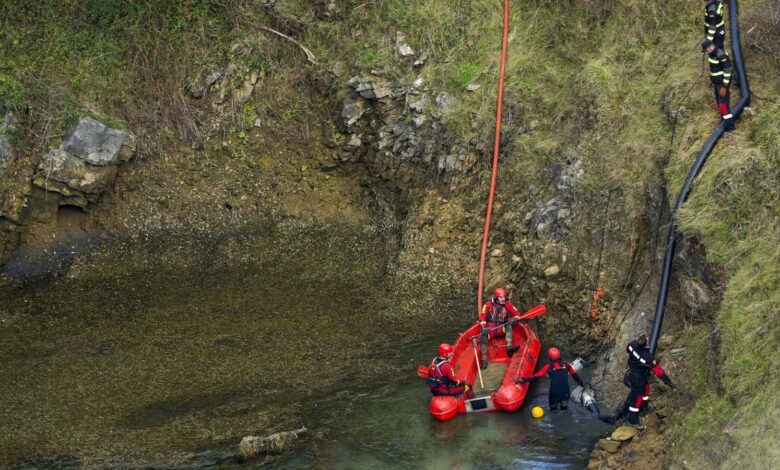
The still waters of the Berbes reservoir (Berbes), located in the municipality of Ribadesella (Ribadesella), have once again become the focus of attention. Decades after the mysterious disappearance of a woman and her young daughter, a large-scale operation has been launched here to search for evidence. Since early morning, specialists from various agencies, including military and police, have resumed pumping water to reach submerged vehicles that may hold answers to questions that have plagued investigators since 1987.
The work is challenging: a thick layer of silt hinders progress, and the equipment is being pushed to its limits. In the past 24 hours, about 2,500 cubic meters of water have been removed, but there’s still a long way to the bottom. Tensions are high—if the vehicles are found, it could finally shed light on the fate of the missing mother and child.
Search efforts complicated
Nearly one hundred people are involved in the operation. Members of the Military Emergency Unit (Unidad Militar de Emergencias, UME) are on site, along with officers from various branches of the National Police. Powerful water pumps are being used to speed up the drainage process. Drone specialists, forensic experts, and technical professionals have also joined the search.
The work had to be paused the day before due to nightfall, but operations resumed with the dawn. The main goal is to find two vehicles which, according to the investigation, were submerged in the reservoir in the late 1980s. The remains of the missing woman and her daughter, who disappeared in León (León) in the summer of 1987, may be inside the cars.
Judicial investigation
The search is being conducted by court order. Back in October of last year, a judge from Gijón ordered that all necessary resources be deployed to continue the investigation. Additional personnel were brought in as part of the case involving alleged unlawful deprivation of liberty, and funding was allocated for complex technical operations.
The investigation intensified after the police received a report stating that the search could not continue due to a lack of equipment. Now that all necessary resources have been provided, work is progressing at full speed. Investigators hope that the objects found in the raft will help reconstruct what happened nearly forty years ago.
Details of the disappearance
A woman and her one-year-old daughter disappeared between June 26 and July 15, 1987. Their last known address was in Gijón. Shortly after their disappearance, the main suspect was detained and imprisoned, but he was not actually found until two years later. There was no information about the missing woman and child in Spain or other European countries, including France, Switzerland, and Portugal. Investigators believe it is unlikely that the mother and child could have survived without social support.
In recent months, attention to the case has renewed. New technical means for examining the reservoir bed have enabled the search to resume. Authorities do not rule out that key evidence in this high-profile case may be found specifically in Berbes.
Technical challenges
A thick layer of silt and the complex bottom terrain pose additional challenges for rescuers. Alongside pumps, special underwater equipment is being used. If cars are found, careful work will be required to extract them without damaging potential evidence.
It is still unclear whether rescuers will manage to reach the vehicles today. Nevertheless, experts remain hopeful and continue their work despite fatigue and difficult weather conditions. Every cubic meter of water removed from the balsa brings them closer to unlocking one of modern Spain’s most mysterious disappearance cases.
If you didn’t know, the Unidad Militar de Emergencias (UME) is a specialized branch of the Spanish armed forces created to respond to emergencies, including natural disasters and search and rescue operations. In such cases, the UME works closely with police, firefighters, and other services. Over the years, the unit has taken part in some of the country’s most complex operations, earning a reputation as one of Spain’s most effective rapid response teams.