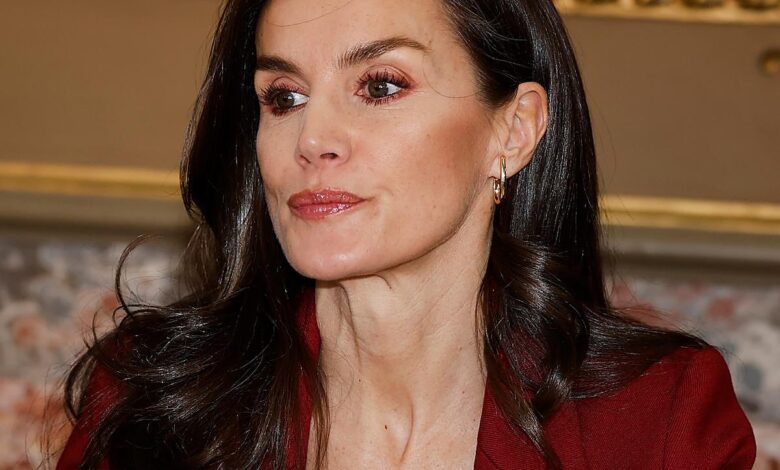
At the beginning of the year, Spain’s fashion industry turned its attention to the Zarzuela Palace, where Queen Letizia hosted a meeting with top designers and organizers of the upcoming Mercedes-Benz Fashion Week Madrid. There are still a few weeks left before the country’s main fashion event kicks off, but the excitement surrounding it is already reaching its peak. For the first time in years, the Queen decided to personally support local couturiers, sending an unexpected signal to the entire industry.
The meeting at the royal family’s residence did not go unnoticed. For many, it was a surprise that the palace officially classified this event as an economic initiative. This approach underscores that fashion in Spain is not only an art, but also an important business that needs support at the highest level. At a time when it is increasingly difficult for young designers to break into the market and competition with global brands continues to intensify, such gestures are particularly significant.
The role of the monarchy
Queen Letizia has long been known for her support of national brands. Her wardrobe choices often make headlines, and her backing of small Spanish labels serves as a model for others. However, despite this, her participation in fashion-related events has always been occasional. Unlike other major exhibitions, such as the Fitur tourism fair or the Arco art fair, Madrid Fashion Week has rarely enjoyed such evident royal attention.
Experts note that fashion in Spain still cannot rival tourism or contemporary art in terms of economic contribution. Perhaps that is why support from the monarchy does not appear as regularly. The last such notable gesture was recorded in 2022, when Letizia attended an anniversary event but chose not to sit in the front row, instead opting to meet with young designers backstage.
Internal contradictions
The meeting at Zarzuela coincided with the anniversary of Valentina Suárez-Zuloaga’s appointment as creative director of Madrid Fashion Week. Her mission is to bring Spanish fashion to the international stage, and it was to the queen that she appealed for support. This time, Letizia responded by inviting not only the organizers but all designers who will present their collections in March.
Among the invitees are 13 participants from the main program and several dozen representatives from other sections. Particular attention was drawn to the possible attendance of Ágatha Ruiz de la Prada, the most experienced participant, who has repeatedly expressed critical opinions about the queen. Her statements that elegance matters more than appearance to a monarch sparked intense debate within the professional community. Whether she will appear at the reception remains an open question, fueling interest in the event.
Fashion and the economy
For Spanish designers, support from the monarchy is more than just a symbolic gesture. It is a genuine opportunity to attract the attention of investors and buyers, as well as to strengthen their position in both domestic and international markets. In recent years, digital platforms have opened new opportunities for young talents, but competition with global brands remains fierce. In such circumstances, even occasional support from the royal family can prove decisive.
However, not everyone in the industry shares this optimism. Some believe the monarchy’s interest in fashion is more episodic and does not lead to systemic change. Others, on the contrary, are convinced that even rare gestures can change public attitudes toward national brands and boost their prestige.
Personalities and ambitions
This year, the main stage of Mercedes-Benz Fashion Week Madrid will see performances from both established masters and newcomers. Among them are Baro Lucas, Kossu x Miguel Palacio, Custo Barcelona, Feli Campo, Hannibal Laguna, Lola Casademunt, Maison Mesa, Malne, Menchén Tomás, Odette Álvarez, Simorra, and Yolancris. Each hopes the queen’s attention will help elevate their collections to a new level.
A special place is held by Valentina Suárez-Zuloaga, who, in just one year as creative director, has already made her mark as a reformer. Her ambition is to turn Madrid Fashion Week into not only a national but also an international event capable of competing with Paris and Milan. In this context, Letizia’s support becomes strategically important.
Queen Letizia is one of the most talked-about figures in contemporary Spain. Her style and fashion choices regularly spark debate and inspire millions of women. Over the years on the throne, she has repeatedly shown loyalty to national brands, enabling many of them to reach new heights. At the same time, her interactions with the fashion industry have often been marked by controversy and unexpected twists, fueling even greater interest in her every move.