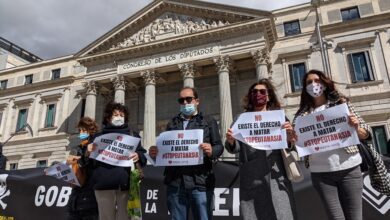
Events in the Spanish Congress have once again drawn attention to how political decisions can be abruptly changed under pressure from public demonstrations. The failure of the vote on the so-called “omnibus decree” concerning pensions was not only a setback for government plans but also triggered a loud protest that shook the parliamentary chamber. For Spaniards, this is more than just another parliamentary scandal — it concerns issues that directly impact the rights of pensioners and homeowners.
At the center of attention was activist Felícitas Velázquez, known for her involvement in the Sumar movement and her longstanding advocacy for housing rights. Her appearance in the Congress chamber after the failed vote was no accident. Dressed in blue loungewear, Velázquez loudly expressed her support for housing occupations, accusing deputies of defending the interests of the wealthy. Her speech marked the high point of a carefully orchestrated campaign aimed at increasing pressure on politicians after the government’s setback.
Political Maneuvers
The decree proposed by the government included not only pension increases but also a series of controversial measures, among them a ban on cutting off utilities for illegal occupants (okupas), even if they fail to pay their bills. This initiative was sharply rejected by the opposition, primarily the Partido Popular (PP), which insisted on a ‘clean’ law focusing solely on pensions. According to PP representatives, the government was attempting to combine unrelated issues in one document to secure support from allies and maintain political stability.
In response to the failed vote, a real battle for the information agenda unfolded in the halls of Congress. Several hours before the session, a video was already prepared at the prime minister’s residence in which Pedro Sánchez accused the opposition of refusing to support pensioners. However, the video contained contentious claims that PP representatives immediately refuted, reminding everyone that it was the Socialists who once froze pensions, not their party.
Protest action
The appearance of Felicitas Velázquez in the chamber was not spontaneous. According to sources close to Sumar, her invitation was part of a carefully crafted strategy. Velázquez is a well-known figure in the leftist activist movement: for decades she has fought for affordable housing, taken part in anti-eviction actions, and signed open letters opposing PP policies. Her outspoken speech, in which she accused MPs of protecting the interests of wealthy citizens, received mixed reactions: some saw it as an act of civic bravery, while others called it an attempt to manipulate public opinion.
After the incident, Velázquez was spotted with two elderly men at the back entrance of the parliament building. Judging by their conversation, the action had been pre-arranged: “Call Paco, tell him I’ve already done my part, we’ve completed the plan,” the activist laughed. This episode only reinforced suspicions that the protest was part of a broader political play.
Opposition response
While the consequences of the failed decree were being discussed in the session hall, PP leader Alberto Núñez Feijóo met with a group of pensioners affected by the so-called ‘inquiokupación’ – a situation where tenants stop paying rent and property owners are left vulnerable. According to Feijóo, the party cannot support laws that force pensioners to choose between keeping their homes and receiving their pensions. He emphasized that the state must protect property owners’ rights rather than shifting responsibility onto ordinary citizens.
This time, the opposition decided not to compromise, refusing to support a package law that tied a pension increase to measures protecting illegal occupants. PP representatives insisted that such issues should be addressed separately, without political ‘traps’ or attempts to please everyone at once.
Consequences and reactions
The incident with the interrupted session and the activist’s high-profile protest triggered heated debate in Spanish society. For many, this case became a symbol of how political decisions can be blocked not only by MPs’ votes but also by public pressure. Once again, the issue of how to balance protecting social rights and upholding the law moved to the center of public discussion.
While the government and opposition trade accusations of manipulation, Spaniards are watching events unfold, trying to determine who truly defends their interests. The situation with the pension decree and the protest in Congress has made it clear that the fight for social guarantees in Spain is becoming increasingly intense and unpredictable.