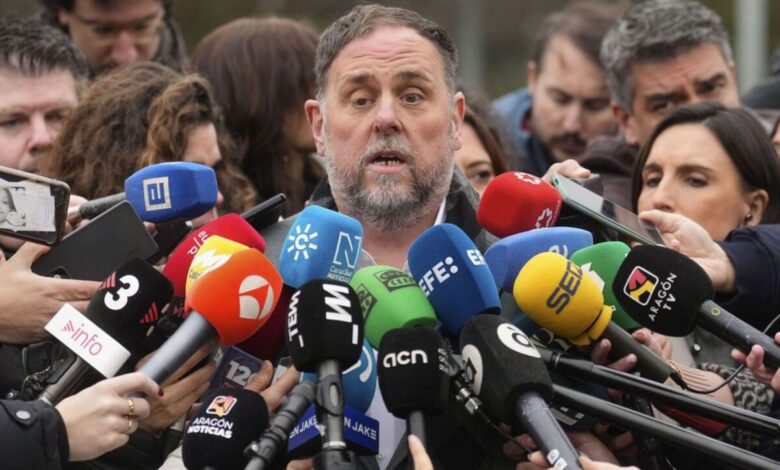
Interest in the relationship between Spain’s central government and Catalan leaders has flared up again in Spanish politics. It has emerged that, prior to the widely publicized January 8 meeting at the Moncloa residence, Prime Minister Pedro Sánchez and Esquerra Republicana de Catalunya leader Oriol Junqueras held two private discussions. These meetings were not announced to the public and only came to light after Junqueras mentioned them during a recent speech.
The government press office, caught off guard by journalists’ questions, was unable to immediately comment on the details of these talks. Government spokesperson Elma Saiz stated that she was unaware of such contacts but emphasized that the executive is always open to dialogue. Nevertheless, it later became clear that the meetings did take place, though the exact dates and circumstances remain undisclosed.
Secret negotiations
The issue of what was discussed in these private talks remains unresolved. All that is known is that they preceded the official dialogue, during which a new approach to regional funding was discussed. This very issue has been a major sticking point between Madrid and Barcelona in recent years. Catalan politicians have long sought greater control over financial resources and, judging by the situation, the informal meetings became an important part of preparing for official agreements.
Interestingly, neither side is in a hurry to disclose the details of these talks. There are rumors in political circles that key decisions are made precisely at such informal meetings and only formally approved in public later. This fuels irritation among the opposition and distrust among some segments of society, as transparency in government is one of the main principles of modern democracy.
Government response
After news of the secret negotiations leaked to the press, the government found itself in an awkward position. On one hand, official Madrid insists on openness and a willingness to engage in dialogue with Catalonia. On the other, the fact of discreet meetings with the separatist leader raises questions about the honesty and transparency of the process.
Addressing journalists, Elma Sais tried to smooth things over by stating that the executive branch always acts in the national interest and is open to discussing any issues. However, the lack of specifics only heightened public interest. In the corridors of parliament, some are asking whether these meetings might have been an attempt to agree on something important away from the spotlight.
Catalan angle
The Catalan issue remains one of the most contentious topics in Spanish politics. Since the events of 2017, when Catalonia attempted to hold an independence referendum, relations between Barcelona and Madrid have not returned to their previous level of trust. Any talks between the central government and Catalan leaders spark a storm of emotions and speculation.
Despite previous legal actions against him, Junqueras continues to play a key role in negotiations with Madrid. His participation in closed-door meetings with Sánchez only confirms that the Catalan issue remains unresolved, with decisions being made not just at official talks, but also behind closed doors.
Financial aspect
The main topic of the January negotiations was a new mechanism for distributing finances among the autonomous communities. Catalonia insists on increasing its share and gaining greater autonomy in budget management. Following the official meeting, it was announced that a fundamentally new approach had been agreed upon, which, according to Junqueras, will bring the region additional billions of euros.
However, the details of the agreement remain unclear. There is growing public discontent over such important decisions being made in a narrow circle, without broad discussion or consideration of the views of other regions. Many fear that this practice could lead to new conflicts and fuel separatist sentiments.
Unanswered questions
The story of Sánchez and Junqueras’s secret meetings once again raises concerns about government transparency and public trust in political processes. Why are such important negotiations held behind closed doors? What are the participants afraid of? And what are the real agreements achieved through these informal talks?
So far, neither the government nor the Catalan leaders are in a hurry to reveal their hand. We can only guess what decisions were made during these closed-door talks and how they will impact the future of Spain and Catalonia. One thing is clear: the political intrigue surrounding the Catalan issue is far from over, and many unexpected twists still lie ahead.