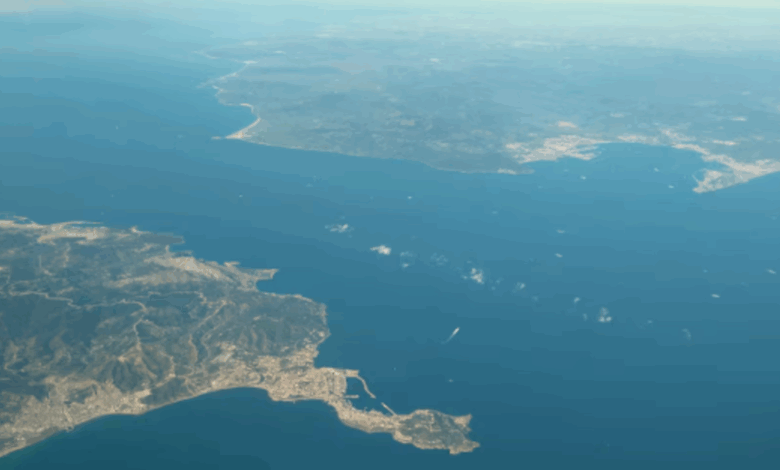
Plans to connect Spain and Morocco with a railway tunnel under the Strait of Gibraltar (Estrecho de Gibraltar) are once again being discussed at the highest level. Despite years of debate, technical assessments, and shifting priorities, the idea has not been shelved. On the contrary, both countries still view the project as a strategic move that could reshape the transport map of Europe and Africa.
The concept of a permanent link between the two continents first emerged in the late 1970s. Back then, economic growth and expanding international ties prompted the search for new routes. By the 1980s, a special Spanish company was established to study the issue, with a counterpart set up in Morocco. Over the decades, the project has undergone many transformations: from the idea of a bridge to the more realistic option of an underwater rail tunnel.
Technical challenges and financial hurdles
The region’s complex geology, considerable depth, and seismic activity ruled out a bridge design. As a result, efforts have focused on a railway tunnel. In recent years, tens of millions of euros have been spent on preparatory work and studies. Since 2016 alone, Spain has allocated more than two million euros for this purpose, with the 2023 budget increasing by an additional €2.25 million.
The project involves leading global companies specializing in tunnel construction. The latest technical reports confirm that building the tunnel is feasible, but numerous challenges must be overcome. These include drilling at depths of up to 475 meters, unstable rock formations, and a constant risk of earthquakes. The plan includes three parallel galleries: two for train traffic and one for technical needs and evacuation.
Timing and Prospects
A final decision to begin construction has not yet been made. Spain and Morocco have given themselves until 2027 to assess all risks and opportunities. If the project gets the green light, preparatory work will not start before 2030, and the tunnel could open as late as 2040. The underwater section will stretch about 28 kilometers, with a total length of 42 kilometers. The route will run between Punta Paloma in Cádiz and Punta Malabata near Tánger.
The tunnel is expected to provide a direct connection between the rail networks of Europe and the Maghreb. This will open up new opportunities for passenger and freight transport between Madrid, Paris, Rabat, and Casablanca. In essence, it aims to create a counterpart to the Eurotunnel, but under far more challenging conditions.
The Future Remains Uncertain
The project’s cost is estimated at €8.5 billion for the Spanish section alone. Part of the funding is expected to come from European funds to ease the burden on the national budget. For now, most of the investment is being spent on geological surveys and preparing documentation.
If implemented, the project would be one of the most ambitious engineering feats of the 21st century. For now, however, the tunnel remains in the planning stage, while the Strait of Gibraltar continues to serve as a symbolic boundary between two worlds.