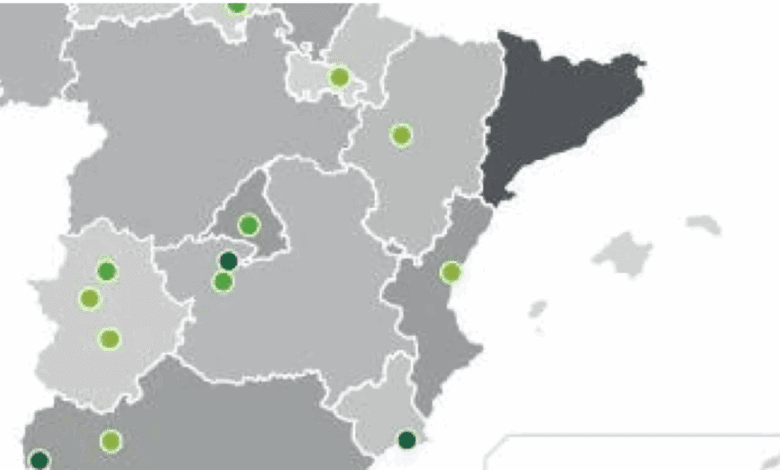
In the coming years, Spain could see an economic leap if it carries out its ambitious plans to build data centers, advanced manufacturing plants, and facilities linked to renewable energy. These initiatives are expected to generate more than €44 billion in additional industrial value for the country. The scope of these changes extends to almost all regions except Castilla y León and the island territories. The list ranges from methanol production plants in Asturias to major data centers in Madrid and expansive hydrogen valleys in Andalucía.
In recent years, Spain has become a magnet for foreign investors attracted by low electricity prices driven by the growth of green energy. Until now, however, it has remained unclear exactly how many projects are in the pipeline and where they will be located. Investors often negotiated with several regional authorities at once, leading to confusion and inflated expectations over the number of future enterprises.
Energy and Industry
The spotlight is on the future of nuclear energy. If the operational life of all existing Spanish nuclear power plants is extended beyond 2035, industry could save about 1.4 billion euros annually on energy costs. This is because nuclear generation can reduce wholesale electricity prices by approximately 14 euros per megawatt-hour. Such a move is particularly important for regions with developed industry: Catalonia, País Vasco, Andalucía, and Valencia. Most of these regions have nuclear plants either within their territory or very close by—for example, Catalonia hosts the Ascó and Valdellós plants, Valencia has Cofrentes, and Andalucía is near Almaraz.
Preserving nuclear generation will help maintain the competitiveness of Spanish industry amid rising global energy prices. This will not only reduce costs but also help preserve jobs, which is especially important in regions where industry has traditionally played a key role.
New projects
The industrial development vector is shifting toward new sectors. Andalucía is planning the creation of two major hydrogen valleys—in Palos de la Frontera and San Roque—each potentially adding 1.5 billion euros to the regional economy. In addition, the north of Huelva province is expected to launch a large mining complex extracting zinc, lead, and copper, which could bring in another 450 million euros.
Murcia is preparing to launch a major green hydrogen plant — the Cartagena Large Electrolyzer — which could generate an additional €340 million for the region. Extremadura is becoming a hub for several innovative projects: data centers expected to generate up to €15 billion in added value, a battery cathode production facility (€800 million), and a synthetic diamond plant in Trujillo, where Leonardo DiCaprio is among the investors, with an estimated investment of €730 million.
Technologies and Regions
In Valencia, construction has already begun on a battery production plant in Sagunto, projected to contribute €10 billion to the regional economy. Zaragoza is set to host another battery facility with a potential value of €4.1 billion. Castilla–La Mancha will see the opening of a sustainable aviation fuel (SAF) plant capable of adding €4 billion, as well as data centers with a combined value of €750 million.
Madrid isn’t standing by: new data centers under construction here could bring in €930 million. But the greatest potential in this segment belongs to the Altamira project in Cantabria, estimated at €3.6 billion. Asturias is set for a renewable methanol production plant worth €250 million, while Galicia will gain a facility projected to add €190 million.
Industrial Map
Traditional industrial regions such as Catalonia and the Basque Country may miss out on major new projects this time. The main investments and innovations are increasingly shifting to the southern and western regions of the country. This could alter the balance of economic power between regions and create new hubs for high-tech manufacturing.
Overall, Spain stands on the threshold of sweeping change. If all announced projects are implemented, the country will not only gain new jobs and boost GDP, but also have a chance to become a leader in Europe’s industrial transformation. However, much will depend on how quickly stable energy supplies can be secured and a favorable climate for investors created. Time will tell whether these new industries can reshape the country’s economic landscape.