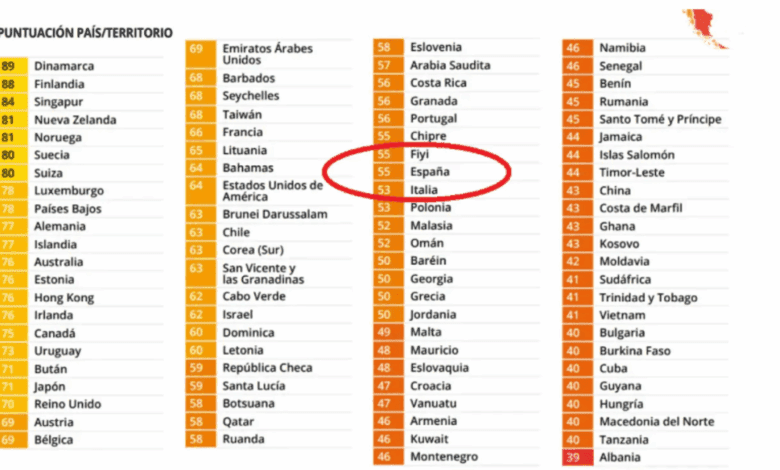
Spain’s drop in the international Corruption Perceptions Index has become a worrying signal for society and business. The country’s new position—49th out of 182—reflects not only a tarnished image but also real risks for the economy, investment, and trust in institutions. The score’s decline from 62 to 55 over six years indicates that anti-corruption efforts are stalling and that oversight and transparency mechanisms are losing effectiveness.
This year, Spain has lagged behind countries like Grenada, Rwanda, and Botswana—something that would have seemed impossible not long ago. Even Saudi Arabia and Israel received higher marks. At the same time, Italy, a country traditionally associated with corruption scandals, trails Spain by just two points. Most EU countries are experiencing a similar trend: falling scores and growing skepticism toward anti-corruption standards. Experts note that in Europe, the sense of impunity and weakening oversight over power is mounting.
Global trends
The global average score this year was 42, one point lower than last year. More than two-thirds of countries failed to pass the 50-point threshold, and the number of states scoring above 80 dropped to five. Denmark, Finland, and Singapore remain at the top of the ranking, while Venezuela, Somalia, and South Sudan are at the bottom. In these countries, corruption pervades all levels of government and has become part of the system.
In several countries, including Azerbaijan, corruption is systemic, affecting every aspect of life. At the same time, some nations are experiencing politically motivated pressure on NGOs monitoring those in power. In Georgia, Indonesia, Peru, and Tunisia, authorities are restricting funding and attempting to dismantle independent organizations, which complicates efforts to fight corruption and makes the work of journalists and activists dangerous.
Democracy faces new risks
Hundreds of countries maintained their positions in the ranking, but 50 dropped while only 31 managed to improve. Particularly concerning is the trend of worsening conditions in countries with established democratic institutions. Among them are the United States, Canada, New Zealand, the United Kingdom, France, and Sweden. This suggests that even advanced democracies encounter challenges of transparency and accountability.
Organizations specializing in corruption analysis emphasize that the world needs principled leaders and strong, independent institutions. Only then can public interests be protected and trust in government restored. However, in recent years, there have been too many failures in governance and accountability. Despite this, experts are confident: corruption is not inevitable, and countries whose governments carry out consistent reforms are showing positive changes.
Press freedom under threat
Particular attention is given to the role of media and journalists in exposing corruption schemes. In recent years, 829 journalists have been killed worldwide, 150 of whom were investigating corruption. In 2025 alone, five reporters lost their lives, including Turki Al Jasser, executed in Saudi Arabia after seven years in prison, and Gastón Medina, shot outside his home in Peru. More than 90% of these crimes occurred in countries with a low Corruption Perceptions Index, such as Brazil, India, Mexico, Pakistan, and Iraq.
Under these circumstances, independent journalists, civil activists, and whistleblowers find it increasingly difficult to carry out their work. Authorities use laws, smear campaigns, and intimidation to limit freedom of speech and conceal corrupt practices. This creates an atmosphere of fear and further fuels the spread of abuses.
Context and recent events
In recent years, Spain has not been the only country to see a decline in anti-corruption rankings. Similar trends have been observed in France and the United Kingdom, where public dissatisfaction with corruption scandals has led to mass protests and the resignation of officials. In Italy, a series of high-profile investigations prompted the adoption of new laws, but their effectiveness remains in question. In Latin America, particularly in Brazil and Mexico, journalists and activists continue to face threats and violence, while trust in the authorities remains low. In contrast, Northern European countries maintain a high level of transparency, as confirmed by their stable positions in the rankings. These examples show that the fight against corruption demands constant effort and does not allow for complacency.