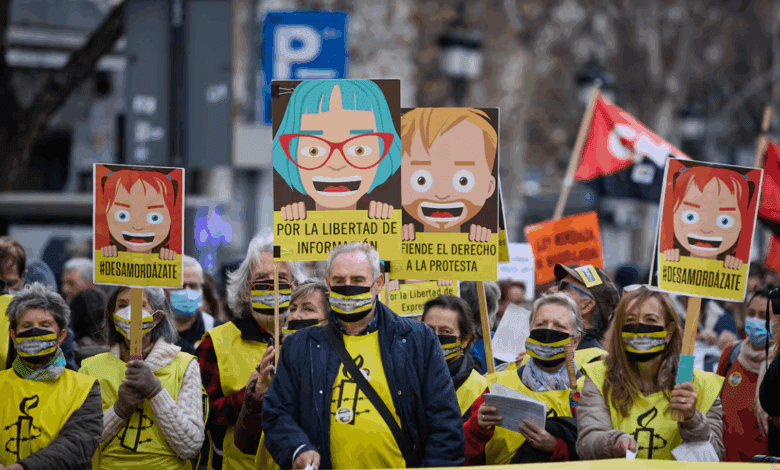
In Spain, a new controversy has erupted over the reform of the Citizen Security Law, commonly referred to as the ‘gag law.’ This issue directly affects citizens’ rights and freedoms, as well as police operations and the relationship between society and authorities. Despite agreements reached by the main parties in 2024, the process of passing amendments has stalled due to the complex balance of power in parliament and ongoing disputes among political factions.
Political barriers
At the beginning of 2026, nearly a year and a half after the reform passed its initial discussion, it has made no further progress. Although it initially appeared that an agreement between PSOE, Sumar, and EH Bildu—later supported by ERC, PNV, and BNG—would pave the way for change, reality proved otherwise. Junts’ decision to withdraw from the coalition agreement with Pedro Sánchez’s government in October 2025 only made the situation worse. Now, passing any legislation requires a complicated combination of votes, and the lack of unity among left-wing and nationalist parties has made progress virtually impossible.
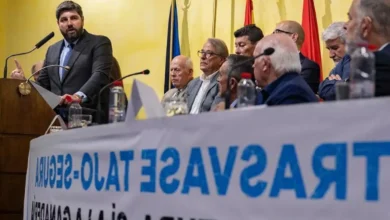
This is already the third attempt to amend the law, which has been in effect since 2015. In 2019, an early parliamentary dissolution derailed the reform, and in 2023, disagreements between PSOE, Unidas Podemos, and PNV on one side, and ERC, Junts, EH Bildu, and BNG on the other, prevented progress. Talks have now been reduced to informal contacts and rare meetings, such as the gathering on June 25, 2026, between representatives from PSOE, Sumar, ERC, EH Bildu, and PNV—which yielded no significant results.
Key stumbling blocks
The main disagreements center around four points: the use of rubber bullets to disperse protests, punishments for disrespecting the police, liability for disobeying law enforcement officers, and the procedure for the swift deportation of illegal migrants at the border. Junts, Podemos, and BNG are demanding a complete ban on rubber bullets, EH Bildu and ERC propose a transitional period, while PSOE, Sumar, and PNV insist on a gradual replacement of these means and the development of new protocols without specifying a concrete timeline.
Political differences are further intensified by internal competition between parties. For example, Junts, according to some negotiators, fears losing voter support amid the growing popularity of the far-right in Catalonia. At the same time, PNV is accused of altering previously agreed positions, although party representatives deny this. Inside PSOE, there is acknowledgement that progress on the reform has stalled, but they emphasize their willingness to keep moving forward despite tough conditions.
Mutual accusations
In recent months, the negotiations have barely progressed. Parliamentary groups accuse each other of inaction and a lack of political will. Some believe that PSOE deliberately slows consideration of contentious initiatives to avoid new defeats in parliament. Others point to the ‘inertia’ of Podemos and the unwillingness of Junts to compromise. As a result, despite the majority of parties formally agreeing on several articles, key issues remain unresolved.
The situation is reminiscent of recent political crises, when pressure on the government sharply increases due to internal conflicts and public discontent. For example, in the case of the investigation into the tragedy in Adamuz, when the opposition demanded immediate explanations from Sanchez and the head of Madrid insisted on his resignation, which was analyzed in detail in the article about political pressure following the Adamuz incident.
Context and consequences
As El Pais reports, the lack of progress on security law reform reflects the broader trend of political fragmentation in Spain. With no party able to secure a stable majority, even socially important initiatives end up blocked. This creates an atmosphere of uncertainty and heightens mistrust toward state institutions.
In recent years, Spain has repeatedly encountered situations where reforms affecting civil rights have stalled due to political disagreements. For instance, attempts to change labor laws or reform the education system have also repeatedly bogged down in parliament. Such processes mean that even after preliminary agreements are reached, real changes are postponed indefinitely, and public tension only continues to rise.