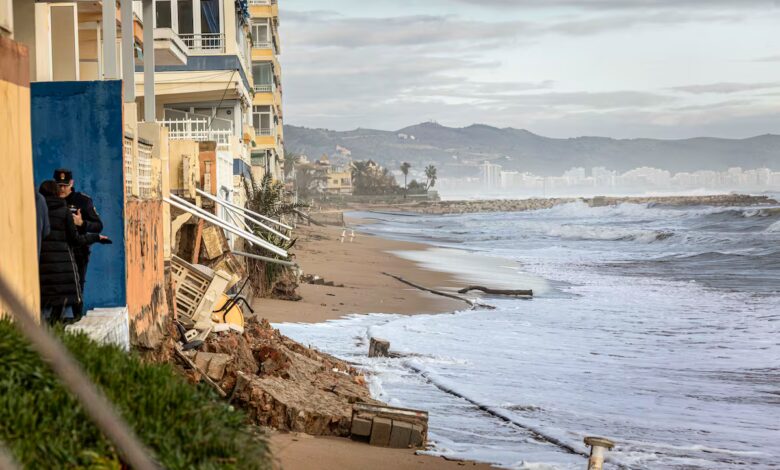
In Tavernes de la Valldigna, on the Valencian coast, life came to a halt after a powerful storm literally tore off a section of a residential building’s facade. Ocean waves up to seven meters high crashed into the city, leaving behind not only destruction but also anxiety among locals. Three families were forced to urgently leave their apartments when part of the wall supporting the terraces collapsed under the force of the elements. Now, after several days of waiting and inspections by specialists, it has been announced: residents will be able to return to their apartments as early as next week.
The building management assures that the main structure was not damaged and only secondary elements were affected. Nevertheless, fear and uncertainty still haunt those impacted. They had to endure not just the evacuation itself but also days of not knowing whether they would ever return home. Now that experts have confirmed the building is safe, all that’s left is to reinforce the terraces and apply for financial assistance.
Emergency measures
City officials admit: the situation has become a real challenge for everyone. The mayor of Tavernes de la Valldigna, Clara Romero, called it a “tragedy” and stressed that the city had never seen such a force of nature. According to her, ensuring the safety of residents and preventing further collapses has been and remains the top priority. The authorities immediately appealed to the central government for urgent action, as the mayor believes similar disasters could happen again in the future.
In response to requests from local officials, government representatives promised to provide more than 45,000 cubic meters of sand to restore the beach. This is expected not only to return the coastline to its previous state but also to protect the city from further destruction. However, many experts are convinced that without comprehensive solutions and long-term investment, such measures are just a temporary reprieve.
Coastal problems
The director of coastal, port and airport affairs, Marc García, stated during an inspection that the damage could have been minimized if long-planned shoreline reinforcement works had not been delayed for years. He noted that such destruction is seen not only in Tavernes de la Valldigna, but also in other coastal towns such as Sagunto, Moncofa, and Altea.
Particular concern is caused by buildings located on the front line by the sea. According to García, if urgent measures—such as installing breakwaters and reinforcing foundations—are not taken, the consequences could be much more serious. He insists on starting the work immediately to prevent further tragedies.
Record investments
The authorities of the Valencian Community emphasize that unprecedented funds have been allocated to protect the coastline. According to government delegate Pilar Bernabé, since 2018 more than 373 million euros have been invested into restoring and strengthening the shore. More than 21 million euros will be spent on upcoming beach regeneration projects alone, including Brosquil and La Goleta.
Bernabé noted that inspections and emergency works have already begun, and by summer the beaches should be fully restored. In 2026, as part of the national recovery plan, another 43 million euros will be invested in the Valencian coast—the largest amount in the country’s history allocated to fight marine erosion.
Race against time
Local residents and experts agree: climate change is making such disasters increasingly frequent. Authorities are forced to react quickly, but many decisions are made too late. In Tavernes de la Valldigna, destructive storms are nothing new, and each time the consequences are growing more severe.
While officials promise urgent measures and new projects, city residents hope for just one thing — that their homes will no longer become hostages to the elements. But unless the approach to coastal protection changes, similar incidents could happen again at any time. In that case, the issue will concern not only repairing buildings, but also the future of entire coastal neighborhoods.