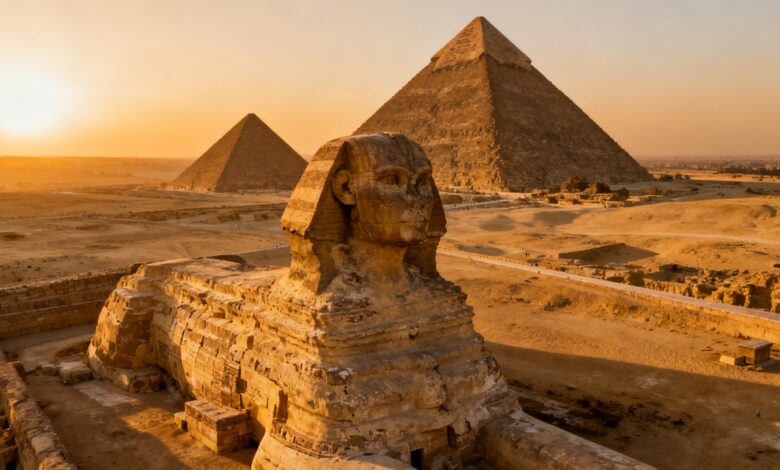
Spain revisits sensational theories on the origins of the Giza pyramids. A new study published on Academia.edu challenges the traditional understanding of the age of the Giza pyramids. The author, independent researcher António Ambrósio, affiliated with a university in Barcelona, suggests they might have been built not by ancient Egyptians but by an unknown civilization thousands of years before the pharaohs. This hypothesis could reshape approaches to history and archaeology, as well as impact educational and cultural initiatives in Spain and Europe.
The author, independent researcher António Ambrósio, claims that the Giza pyramids may be several thousand years older than the official dating suggests. His hypothesis proposes the possible existence of an advanced culture that left behind these monumental structures. Unlike the classical theory, which links the construction of the pyramids to the Fourth Dynasty and specific pharaohs, the researcher suggests viewing them as the legacy of a vanished civilization. This approach has sparked interest among academics and history enthusiasts, but also raises many questions.
Arguments and doubts
Ambrósio’s work highlights four key arguments. The first is the absence of mummies in the main pyramids. None of them contained remains that could be confidently attributed to a specific pharaoh. Official Egyptology explains this by the ancient looting of tombs, but the author argues that the complete lack of burial objects raises questions about their original purpose.
The second argument concerns the precision of construction. The base of the Great Pyramid is aligned with remarkable accuracy, and the finishing of the granite blocks in the ‘King’s Chamber’ appears too perfect for copper tools. At the same time, later pyramids are noticeably inferior in quality. This casts doubt on the idea of a consistent evolution of building techniques in Ancient Egypt.
The third point is related to the erosion of the Sphinx. Some researchers, including Robert Schoch, believe that the damage on the statue may have been caused by heavy rainfall that occurred in the region long before the rise of Egyptian civilization. Opponents of this theory attribute the erosion to other causes, but debates continue.
The fourth argument is the astronomical alignment of the Giza complex. There is a view that the arrangement of the pyramids mirrors the stars of Orion’s Belt. This may indicate that the builders possessed deep astronomical knowledge, which also does not fit the conventional chronology.
Debate and criticism
Within the scientific community in Spain and other countries, such hypotheses spark lively debate. Critics point out that to confirm the existence of an unknown civilization, direct archaeological evidence is needed: settlements, tools, human remains. Since such findings have not been discovered, most specialists adhere to the classical theory of the pyramids’ origins.
At the same time, supporters of alternative theories highlight the lack of clear evidence linking the pyramids to specific pharaohs. The sole inscription bearing the name Keops in one chamber remains disputed by some researchers, although mainstream scholars consider it authentic. The question remains open, and new discoveries may change our understanding of the past.
In Spain, interest in these topics is driven not only by history but also by their impact on educational and cultural initiatives. Debating alternative versions helps develop critical thinking and sparks young people’s interest in archaeology.
Context and consequences
If the hypothesis of a more ancient origin for the pyramids is accepted, many aspects of Egypt’s history would require reassessment. This would affect not only academic publications, but also the tourism industry, educational curricula, and cultural projects. In Spain, such debates often become a catalyst for public discussion and new research.
According to RUSSPAIN, interest in alternative versions of history has been growing in Europe in recent years. New publications, documentaries, and exhibitions dedicated to the mysteries of ancient civilizations have been emerging. In 2024, a major conference was held in Madrid to discuss controversial issues in archaeology and history. Such events foster scientific dialogue and broaden the horizons of a wide audience.
In recent years, various hypotheses about ancient structures, whose age may greatly exceed official estimates, have surfaced around the world. For example, in Turkey, debates focus on the age of the Göbekli Tepe complex, while in South America, the mysteries of megalithic structures draw attention. These topics interest not only specialists but also a broad audience, which is reflected in the popularity of science media and educational programs. In Spain, such discussions are becoming part of cultural life and help shape new perspectives on the past.