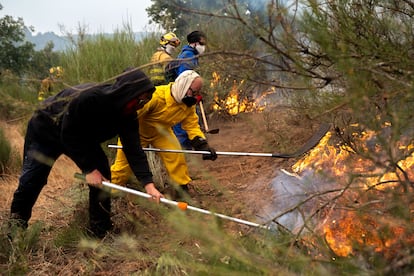
In the vicinity of the village of Filiel in the province of León, once-green fields are now shrouded in thick smoke and the glare of flames. Forest fires sweeping across the Maragatería region have become a major challenge for local services. On the front lines of the firefighting effort are not only official crews but also volunteers, who respond to blazes in their free time outside of their main jobs.
The weak organization of fire services in the autonomous community of Castilla y León has forced many firefighters to operate independently. Some of them, even though they are part of private contracting companies, join official shifts or help local residents in order to save as much land as possible. These informal groups, which the participants themselves call ‘pirate brigades,’ have already operated not only in León but also in the neighboring province of Zamora.
Volunteer vehicles are easy to recognize: they are covered in a layer of ash, and inside you’ll find work clothes, tools, helmets, saws, bottles of water, and everything else needed to fight fires. In Filiel, one such team is scouting the area before meeting the advancing fire front, which is quickly sweeping toward the road, consuming bushes and dry grass.
Firefighters begin with direct attacks: using special shovels and fire beaters, they knock down the flames to deprive them of oxygen. Aerial support plays a key role—water drops from airplanes slow the fire’s spread and create an opportunity to contain it. Each of these “showers” is greeted as much-needed relief, especially when, after one, the fire front loses its power and only scattered sparks remain.
The firefighters’ faces reveal exhaustion and tension: their eyes redden from smoke, coughing and strained skin reflect the intensity of their work. Despite their fatigue, they persist—people’s safety and the preservation of nature are at stake.
The next efforts focus on containing the fire’s flanks. Simple but effective tools—hoes and shovels—come into play. Firefighters clear dry vegetation so the flames can’t spread further. The metallic clang of their tools sounds over heavy breathing—there’s hardly any clean air left in these areas.
Once the surface fire is contained, the team moves to mid-level work—using machetes and axes to cut down shrubs and trees to keep the flames from leaping to new areas. After the fire is localized, local residents join the final cleanup, using branches to fully extinguish any remaining flames. Later, tractors and bulldozers arrive to help prevent reignition.
The work of volunteers extends beyond just firefighting. After long hours on the front lines, they head to León to take part in protests demanding better working conditions. Despite exhaustion and barely any time for basic rest, these individuals continue to fight not only the flames, but also for their rights.
Firefighters note that they earn about 1,300 euros a month, but during crises are forced to work overtime. Many are afraid to speak openly about the problems for fear of employer sanctions, but cannot stand aside when it comes to the safety of their colleagues and local residents.
The story of volunteer firefighters in León is an example of selflessness and solidarity. Despite the shortcomings of the system and harsh conditions, they continue to protect Spain’s forests, risking their health and sacrificing personal time for the common good.