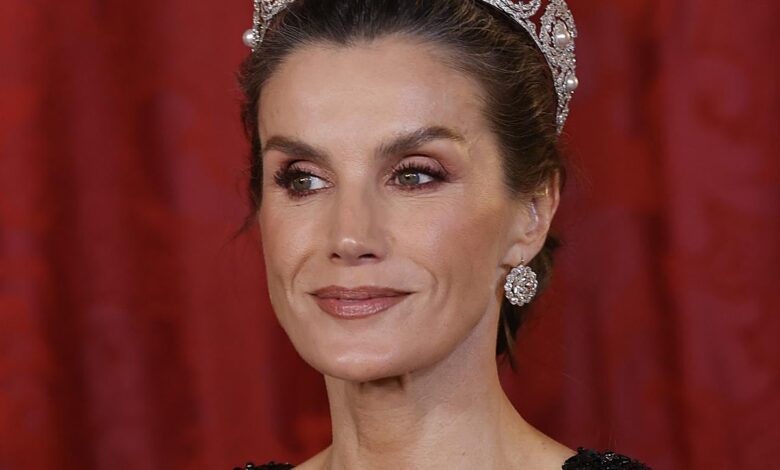
In 2025, Queen Letizia’s style became even more refined and understated than before. Her looks featured minimalism, while her choice of jewelry took on special significance. This year, public attention focused not only on historic gems but also on modern, affordable accessories that Letizia selected for both official and casual occasions.
Tiaras, traditionally associated with royal status, have all but disappeared from Letizia’s wardrobe. Over the past year, she wore a tiara only twice, making each appearance a major event for royal fashion enthusiasts. For 500 days, the queen refrained from wearing these symbols of monarchy in public, which only fueled interest in her rare appearances with them.
Rare tiaras
The first of the two tiaras Letizia chose in 2025 was the renowned Cartier tiara. Previously, she had worn it only once—in 2018 at a dinner honoring the President of Portugal. This time, the queen surprised the public by pairing the tiara with loose hair, giving her look a modern twist. This tiara has a storied past: it once belonged to Queen Sofia, and Infanta Cristina wore it to the wedding of Swedish Princess Victoria. The piece can now be seen at an exhibition dedicated to Victoria Eugenie of Battenberg, as Alfonso XIII originally gifted the tiara to her. Initially adorned with emeralds, these stones were later replaced with pearls.
For the second time, Letizia chose the so-called Russian Tiara, crafted from platinum, pearls, and diamonds. Its design is inspired by traditional Russian kokoshniks. The tiara originally belonged to Maria Christina of Habsburg, then passed to Maria de las Mercedes, grandmother of the current king Felipe. For Letizia, this was only the third occasion she wore this piece, and once again she opted for her hair down—an unexpected choice for such a formal accessory.
Accessible brands
Despite her rare appearances in historic jewelry, in 2025 Queen Letizia embraced pieces by contemporary Spanish brands. She especially favored handcrafted items from Suma Cruz, which she selected for her annual appearance at the Atlàntida Mallorca Film Fest. Letizia’s daughter, Leonor, also wore earrings and rings from this nature- and animal-inspired brand.
Among the queen’s favorites were three Valencian brands: Singulary, Sure Jewels, and Boira Glass. Following the devastating consequences of the Dana, Letizia chose to support local designers by wearing their earrings for public events. All these brands offer jewelry priced under 50 euros, making them popular not only with royal fashion followers but also with the general public. Catalan label PDPAOLA also joined her list of favorites, with the queen wearing two of their designs, each costing less than 160 euros.
Costume Jewelry and Personal Symbols
Letizia didn’t limit herself to just Spanish brands. She often chose jewelry that could be found in regular stores. For example, at the Francisco Cerecedo Award ceremony she appeared wearing a chunky Parfois necklace that cost less than 16 euros, and hoop earrings from the same brand for the same price. Such choices highlight the queen’s inclusive approach to style and make her looks more relatable to everyday Spanish women.
However, among all her jewelry, the Coreterno ring holds a special place—Letizia has worn it for three consecutive years. This 18-carat gold piece is engraved with a quote from Dante’s Divine Comedy and an English inscription inside, making it a personal talisman for the queen. It’s valued at around 1,100 euros and has no ties to either the royal collection or current fashion trends, instead reflecting Letizia’s individuality.
If you didn’t know, Queen Letizia is the wife of King Felipe VI and one of the most talked-about figures in Spanish fashion. Before her marriage, she worked as a journalist and TV presenter. Her style is often discussed in the European media, and her choice of jewelry frequently impacts the popularity of Spanish brands. Letizia is known for supporting local designers and isn’t afraid to experiment, mixing luxury and affordable accessories. Her approach to fashion inspires many women in Spain and beyond.