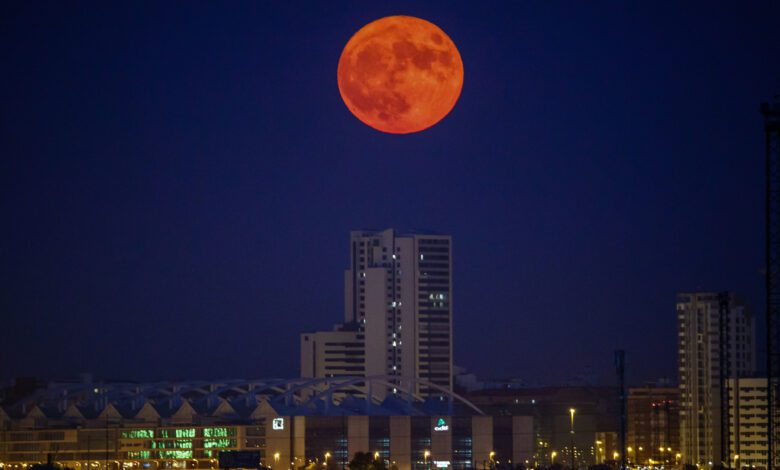
In early November 2025, residents of Spain will have a unique chance to witness one of autumn’s brightest astronomical events — the Beaver Moon. This is not just another phase of Earth’s satellite, but the last opportunity of the year to see a supermoon, when the Moon appears especially large and bright in the night sky.
The name of this full moon originates from the traditions of North American Indigenous peoples. In November, as temperatures drop and days grow shorter, beavers become active, building their dams and preparing for winter. This season gave its name to the November moon. In some regions, it is also called the Frost Moon, highlighting the onset of cold and the first frosts.
In 2025, the Beaver Moon will rise on Wednesday, November 5. On this evening, Earth’s satellite will be at its closest point to our planet, making it especially noticeable even in urban areas. Astronomers note that this will be the last supermoon of the year — an event when the Moon is at perigee and appears larger than usual.
After reaching its full phase, the Moon will begin its journey across the sky, approaching one of the brightest planets — Jupiter. Already on November 9, the satellite will be in close proximity to the giant of the Solar System, passing through the western part of the constellation Gemini (Géminis). The next day, November 10, the Moon will almost touch Jupiter, and by November 11, it will begin to move away, entering the constellation Cancer (Cáncer). This rare convergence will be visible to the naked eye, especially if you find a spot away from city lights.
Lunar cycles have always played an important role in human life. In ancient times, people used them to determine the best times for planting, hunting, and rest. Today, despite technological advances, many still eagerly await the full moon to admire this natural phenomenon. The Beaver Moon is a great reason to step outside, look up at the sky, and feel a connection to nature and history.