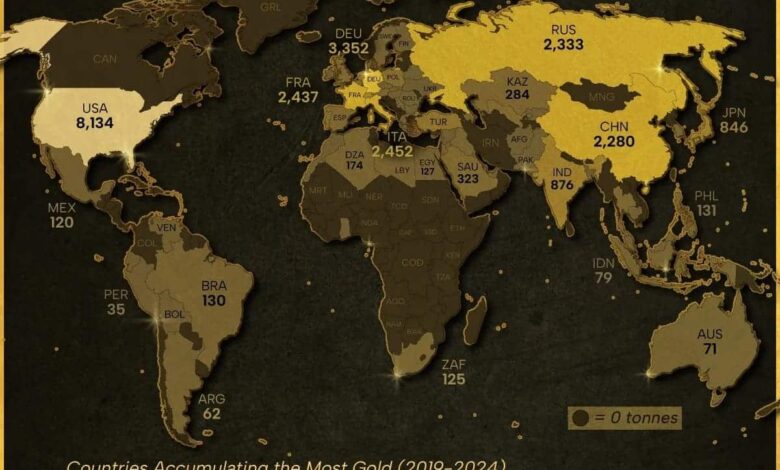
In 2024, the global map of gold reserves has undergone significant changes. A new infographic shows how major economies and emerging markets are building up their precious metal holdings in response to economic and political challenges.
The United States remains the world leader, holding over 8,100 tons of gold. This figure has stayed stable for many years, with most of the gold stored at Fort Knox and the Federal Reserve Bank of New York. America’s gold reserves underpin confidence in the dollar and the country’s financial system.
In Europe, Germany, Italy, and France lead the way. Together, their reserves exceed 8,200 tons, which is comparable to the U.S. These nations inherited substantial gold stocks from the Bretton Woods era, when gold was the backbone of international settlements. Today, European central banks regard gold as a strategic asset capable of shielding their economies from external shocks.
Over the past five years, China has significantly boosted its reserves, bringing them to 2,280 tons. Beijing is steadily diversifying its assets, reducing holdings in U.S. bonds and strengthening the position of the national currency in the global market. The growth of gold reserves is part of a long-term strategy to lessen dependence on the dollar.
Russia ranks fifth, holding 2,333 tonnes. In recent years, the country has actively increased its reserves, using gold as a tool to shield itself from sanctions and currency fluctuations. The Russian Central Bank continues its policy of raising the share of precious metals in the country’s national assets.
Among developing economies, Turkey and Poland stand out. Turkey’s reserves have reached 595 tonnes, while Poland’s total 448 tonnes. Both nations view gold as a safeguard against inflation, currency instability, and geopolitical risks. In recent years, they have significantly stepped up their purchases of the metal, reflecting the global trend toward a return to tangible reserves.
Overall, the global distribution of gold reserves reflects not only economic strength but also states’ strategic priorities. Amid uncertainty and rising geopolitical tensions, gold is once again becoming a key element of financial security for many countries.