Anyone driving near Madrid’s Barajas Airport may witness an almost surreal scene. In the midst of roaring traffic, right at the heart of a giant roundabout, a solitary baroque church stands proudly. The sight feels as if it has been plucked from another era—a historical relic wedged between the concrete and noise of the 21st century. This structure is a living testament to the past, stubbornly resisting oblivion amid the relentless spread of urban development.
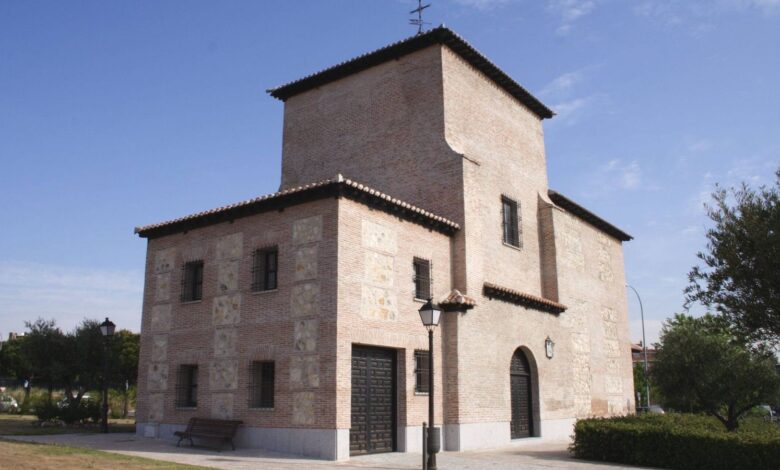
But this isn’t just an old building. It’s the chapel of Nuestra Señora de la Soledad, whose foundation dates back to the mid-17th century. In those days, it was part of a widespread Castilian tradition—a network of hermitages and shrines that served as spiritual landmarks and marked the boundaries of towns and villages. For the people of Barajas, this chapel was an important waypoint, a gateway to their community long before the first airplane touched down nearby. Its understated design, made up of four separate elements—the portico, nave, sanctuary, and the hermit’s dwelling—is a classic example of the era’s architecture, with sturdy brick and stonework highlighting a simple yet elegant form.
The relentless expansion of Madrid and its international airport in the 20th century brought considerable trouble to this quiet chapel. As plans emerged for new roads and highways to link the capital with its gateway to the world, the church found itself directly in the path of progress. Planners seriously considered demolishing it or relocating it stone by stone to another site. However, the local community united to defend their heritage. Their persistence successfully averted the destruction, but victory came at a steep price. The chapel was condemned to a life of isolation: first it stood on the shoulder of a busy road, then it hovered above a new tunnel, and finally it was completely surrounded by the enormous roundabout we see today.
Today, the Ermita de Nuestra Señora de la Soledad has become a hostage to its location. While Sunday services still breathe life into its ancient walls, drawing a handful of local parishioners, its long-term survival remains a constant concern. The building endures relentless exposure to the harsh environment created by the thousands of cars speeding past each day. Corrosive exhaust fumes, constant vibrations, and a layer of grime silently erode its historic structure. Furthermore, both its physical and visual isolation from Barajas make it difficult for people to fully appreciate its significance. Reaching it requires a daring dash across a busy crosswalk—something few are willing to attempt. The chapel, once a symbol of local identity, now finds itself in the shadow of the very infrastructure to which it once gave way.
Incidentally, the Ermita de Nuestra Señora de la Soledad was built between 1635 and 1645. Its architectural style is a modest take on Baroque, featuring elements of Herrerian design typical of Castilian architecture of that era. Despite its vulnerable position, the chapel is officially recognized as a Bien de Interés Cultural, granting it a certain degree of state protection. This status underscores its historical importance not just for the Barajas district, but for all of Madrid.