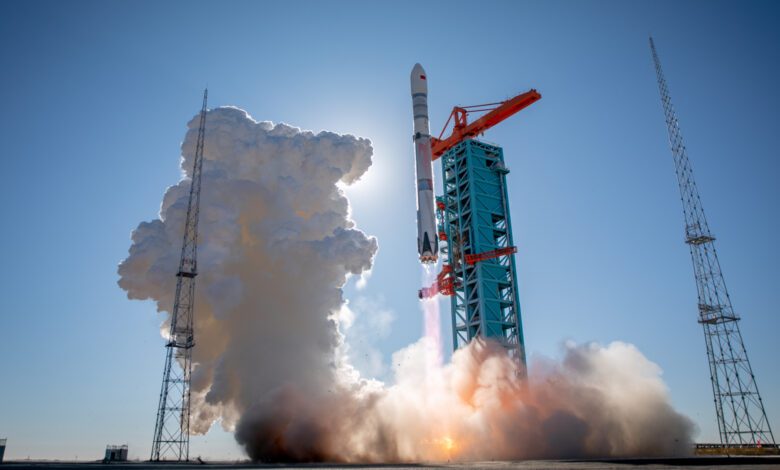
2025 became both a true test and a triumph for China in space exploration. Over twelve months, the country not only broke its own launch record, but also advanced towards reusable rockets, conducted major tests for its lunar program, and dealt for the first time with an emergency in orbit that was resolved without losses. Chinese engineers and scientists showed the world that the nation is ready for new challenges and has no intention of surrendering its leadership in the space race.
This year, China confidently surpassed its previous record for annual launches, which stood at 68 in 2024. By December, the number of attempts exceeded 80—and the figure may still rise. Despite two failures involving private companies, the state-run Long March rocket series maintained a flawless safety record, with no major incidents since 2020.
Special attention was drawn to attempts at developing reusable rockets. Landspace became the first company to send the Zhuque 3 rocket into orbit; however, the first stage failed to land during its return maneuver. By the end of the year, the new reusable Long March 12A rocket is expected to launch, potentially marking a turning point for regular recoverable missions—nearly a decade after SpaceX’s success with Falcon 9.
Megaconstellations and new missions
The surge in launches is largely driven by the construction of two massive satellite constellations: the national Guowang project and the Shanghai-backed Thousand Sails. Each aims to deploy more than 10,000 satellites in response to Western projects like Starlink. This year alone, Guowang saw 15 launches, with projections indicating even more in 2026.
Another milestone was the Tianwen 2 mission, which launched in May. The spacecraft is en route to the asteroid Kamo’oalewa to collect samples and bring them back to Earth. Tianwen 2 marks China’s second deep space expedition following the successful Mars mission in 2020. Notably, the Mars orbiter is still operational and recently captured unique images of the interstellar comet 3I/ATLAS.
In Earth orbit, China conducted an experiment to refuel a satellite at geostationary altitude. This move could significantly extend spacecraft lifespans, reduce space debris, and increase the flexibility in managing orbital assets.
Lunar ambitions
In 2025, China made significant progress in preparing for a crewed lunar landing planned before 2030. Key tests were conducted, including a shortened stage of the new lunar rocket, the launch and landing of a Lanyue lunar module prototype under simulated lunar conditions, and emergency capsule testing for crew. These achievements have heightened concerns in the US that Chinese astronauts might return to the Moon ahead of their American counterparts.
Meanwhile, China continues to expand its Tiangong orbital station. Three missions were initially planned for 2025: the crewed Shenzhou 20 and 21 flights, as well as the Tianzhou 9 cargo ship. However, plans were altered after a crack was discovered in the Shenzhou 20 porthole, likely caused by a collision with space debris. The crew was evacuated to Earth using the incoming Shenzhou 21, while the backup Shenzhou 22 was rapidly prepared and sent into orbit as a “rescue lifeboat.”
Looking Ahead
In 2026, China plans to further ramp up launch frequency, advance reusable rocket tests, and expand launch site infrastructure, including facilities in the Gobi Desert (Jiuquan), on Hainan Island, and at the sea-based launch site in Shandong province. Key missions include the launch of Chang’e 7 to the Moon’s south pole in search of water ice and the joint SMILE project with the European Space Agency to study space weather.
In crewed missions, China is preparing two expeditions to the Tiangong station — Shenzhou 23 and 24. One of these is expected to carry a Pakistani astronaut to orbit for the first time, who will spend several days on the station and return to Earth with two Chinese colleagues. One Chinese taikonaut will remain in orbit for a full year, setting a new national record.
All eyes will be on the maiden flights of the Long March 10 rocket and the Mengzhou spacecraft, both crucial for the lunar program’s success. China is determined to outpace competitors and secure its position as a leading space power.
In case you didn’t know, the China National Space Administration (CNSA) is the government body responsible for implementing the country’s space programs. In recent years, CNSA has propelled China to the forefront of global space launches and ambitious projects. Key achievements include the creation of its own orbital station, successful missions to the Moon and Mars, and the development of a commercial space sector. The agency’s future plans feature a crewed lunar expedition and further exploration of deep space.