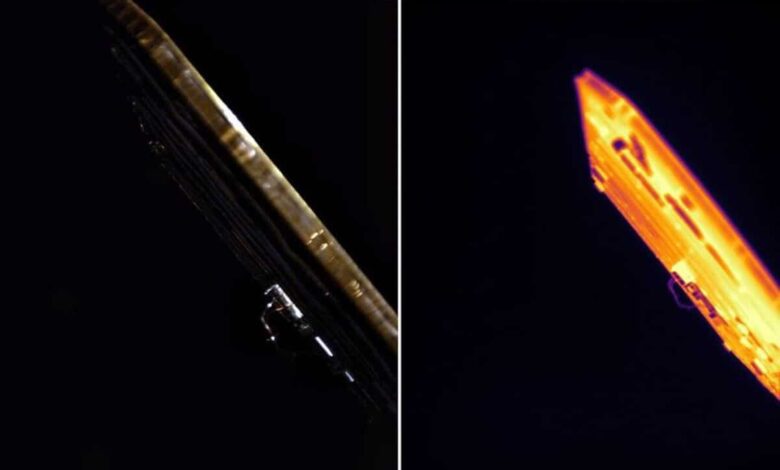
The scientific community has received the first images captured by the ESCAPADE mission spacecraft, currently en route to Mars. The photos were taken using the VISIONS cameras mounted on one of the spacecraft when it was nearly 885,000 kilometers away from Earth. The photographs show part of a solar panel and the surrounding space, providing insight into the condition of the equipment during interplanetary flight.
One image was taken in the visible spectrum, while the other used an infrared sensor. This allows scientists not only to visually monitor the structure, but also to analyze the temperature characteristics of different sections of the solar array. The infrared image clearly shows areas with varying degrees of heating, which is important for assessing the functionality of the systems.
Technology and Objectives of the Mission
Once the spacecraft reach Mars’ orbit, the visible-spectrum camera will be used to observe atmospheric phenomena, particularly to capture Martian auroras. The infrared sensor, in turn, will enable monitoring of temperature changes on the planet’s surface during day-night cycles. This approach will provide new data on Mars’s climate processes and the unique features of its atmosphere.
Both ESCAPADE mission spacecraft are designed to study the magnetosphere of the Red Planet. Special attention will be given to analyzing the interaction between the solar wind and the Martian atmosphere. These processes play a vital role in shaping the climate and evolution of the planet, as well as in questions concerning its potential habitability.
The Scientific Value of the First Images
The first images obtained during the mission have already sparked interest among experts. They not only allow for testing the equipment’s functionality, but also provide insight into how the spacecraft operate in deep space conditions. Such data is essential for fine-tuning ongoing operations and planning future research.
The images also confirm that all spacecraft systems are operating normally, and the cameras can transmit high-quality images over long distances. This is especially important during preparations for the main scientific experiments, which will begin once they reach Martian orbit.
Research Prospects and Next Steps
In the coming months, the spacecraft will continue their journey to Mars, while specialists carefully monitor their condition and analyze incoming data. The main phase of the mission will begin after entering the planet’s orbit, during which scientists hope to obtain unique information about Mars’s magnetic field and atmosphere.
The results of the ESCAPADE mission are expected to provide a better understanding of processes occurring on the Red Planet and help prepare for future manned missions. Additionally, the data collected may be used to develop new technologies to protect spacecraft from solar wind and radiation.
In case you didn’t know: what is the ESCAPADE mission and why is it important for NASA
The ESCAPADE (Escape and Plasma Acceleration and Dynamics Explorers) mission is a joint project by NASA and several scientific institutes aimed at studying the characteristics of Mars’ magnetosphere. As part of the program, two identical spacecraft have been launched to operate in orbit around the Red Planet for several years. The main goal is to study how the solar wind affects Mars’ atmosphere and contributes to its loss into space.
NASA (National Aeronautics and Space Administration) is the leading US space agency, founded in 1958. Over the decades, the agency has carried out hundreds of successful missions, including landing humans on the Moon, sending rovers to Mars, and exploring deep space. In recent years, NASA has been actively expanding its Mars research programs, regarding this planet as key to understanding the evolution of the Solar System and searching for signs of life beyond Earth.
ESCAPADE has become one of the first missions to use two spacecraft simultaneously for collecting data from different points in orbit. This approach provides a more complete picture of the processes occurring in the atmosphere and magnetosphere of Mars. The mission’s success could mark an important step toward future crewed flights and the exploration of the Red Planet.
The project utilizes advanced remote sensing technologies and new methods for transmitting information over long distances. This enables real-time data acquisition and rapid response to any changes in equipment performance. NASA hopes that the experience gained from the ESCAPADE mission will be applied in the preparation of future Mars exploration stages and the exploration of other planets in the Solar System.