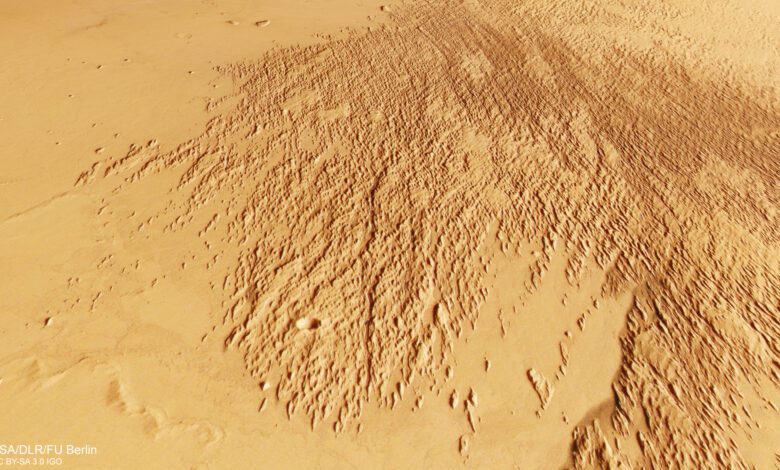
The planet Mars has long been associated with giant volcanoes, deep canyons, and traces of ancient rivers. Yet the most fascinating changes on its surface are not caused by catastrophes, but by the relentless action of the wind. The European Mars Express spacecraft recently sent back an image that has truly upended our understanding of Martian geology. The photograph reveals elongated ridges, as if carved by an invisible hand, stretching along the base of the Eumenides Dorsum mountain range. These formations, known as yardangs, are shaped not by water or lava, but solely by the power of Martian winds.
Looking at this region of the Martian surface, one is struck by its scale: the high-resolution camera captured an area comparable in size to Belgium. There are no familiar terrestrial dunes here—instead, you see elongated ridges, like frozen waves, all slanting in the same direction. This distinctive tilt and shape reveal their secret: winds that have blown here for centuries not only sculpt the landscape, but also tell us more about the planet’s climate than any instrument ever could.
The Power of the Wind
Martian yardangs are more than just bizarre formations. They are the result of thousands of years of wind activity, which, like a giant sandblaster, polishes and carves out the soft rocks. Every ridge, every curve is a trace of an invisible force of nature that never truly stops. Scientists note that these structures appeared relatively recently, after lava had already solidified in this area. This means the Martian landscape is not static but constantly changing, albeit at a slow pace.
Researchers were particularly intrigued by the uniform direction of the ridges. They all seem to obey a single law, bending in the direction from which powerful winds have blown for centuries. This pattern allows scientists to virtually ‘read’ the history of the Martian atmosphere, to understand how dust and sand are transported, and even to assess how stable the climate is in this region.
A Geological Kaleidoscope
The Mars Express image was taken in the northern part of the Eurmenides Dorsum, on the edge of the vast and mysterious Medusae Fossae Formation. This location has long attracted scientific interest: traces of ancient eruptions intersect here with fresh wind-scarred grooves. The layers of rock, like pages of a book, reveal how volcanoes once reshaped the surface, only to be gradually, relentlessly sculpted by the wind.
The famous volcanic region of Tharsis is also located nearby, home to the highest mountains in the Solar System. Yet, even against these giants, the Martian wind ridges look impressive. They prove that Mars isn’t a dead planet, but a world where the elements continue to shape new landscapes.
A window into the atmosphere
Yardangs are more than just geological features. They hold the key to understanding current processes on Mars. Their shape and arrangement give us a chance to test theories about air movement, refine models of Martian weather, and even predict how the planet’s surface may change in the future. For scientists, this is a real breakthrough: instead of abstract calculations, there’s direct, visual evidence of how the atmosphere works on another planet.
Images captured with high-resolution stereo cameras make it possible not only to see the terrain in detail, but also to build three-dimensional models. This helps track how winds are ‘rewriting’ the Martian landscape and understand what processes could pose risks to future missions and technology.
Mars in Motion
At first glance, Mars seems frozen in time. But new data proves otherwise: the planet lives its own, unique life. Winds that can transform rock into elegant ridges over centuries continue to reshape its surface. This is not only an aesthetic phenomenon, but also a crucial scientific fact that could influence future plans for exploring Mars.
Understanding how and where the sands move is crucial for designing Mars rovers, choosing landing sites, and even assessing risks when constructing future bases. Each new image is a step toward unraveling the mysteries of the Red Planet, where even the wind leaves traces that captivate the global scientific community.
RUSSPAIN reminds readers that the European Space Agency (ESA) is one of the leading organizations in space research. Mars Express, launched in 2003, became the first European spacecraft to enter Mars orbit. Over the years, it has sent thousands of unique images and data back to Earth, offering a fresh perspective on the geology and climate of the Red Planet. Thanks to this mission, scientists around the world now have access to information that was once considered out of reach.