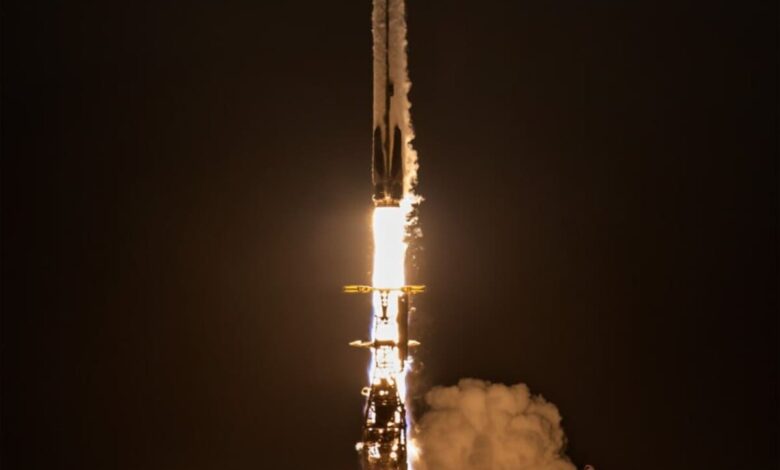
On the evening of November 23, 2025, another Falcon 9 rocket launch took place from the SLC-4E pad at Vandenberg Space Force Base in California. This time, the spotlight was on the first stage booster numbered B1100, which was making its maiden flight. After separating from the second stage, it made a gentle landing on the autonomous drone ship ‘Of Course I Still Love You’ stationed in the Pacific Ocean. The entire operation took just over eight minutes, once again demonstrating the high precision and reliability of SpaceX’s recovery system.
Meanwhile, the payload—a group of new satellites for the global internet network—was successfully deployed into its designated orbit 79 minutes after liftoff. With this, the company continued to expand its orbital constellation, which now exceeds 9,000 satellites.
The Significance of the Anniversary Booster and Numbering Nuances
Special attention was drawn to the number on the booster—B1100. Despite featuring the number 100, this is not the hundredth Falcon 9 booster ever produced. The reason lies in changes to the numbering system introduced in early versions of the rocket. As a result, the actual hundredth stage was B1093, while B1100 received its designation under the revised tracking scheme.
This launch was symbolic for SpaceX, as it demonstrated not only technological continuity but also ongoing improvement of manufacturing processes. The new stage went through all testing phases and was immediately used in an actual mission, underlining the company’s high level of confidence in its engineering solutions.
Launch dynamics and satellite network development
The mission featuring the anniversary stage was the second in just 24 hours: the day before, Falcon 9 launched from Cape Canaveral in Florida, also delivering a batch of satellites to orbit. As a result, SpaceX has reached 150 Falcon 9 launches in 2025—a new record for both the company and the industry as a whole.
Each new launch not only expands the orbital constellation but also advances the technology of rocket reusability. This significantly reduces the cost of launching payloads and accelerates humanity’s progress in space exploration.
Technological achievements and outlook
The landing of the first stage on the ocean platform once again confirmed the effectiveness of SpaceX’s reusable solutions. Automated control systems enabled precise recovery of the stage even in challenging weather conditions, paving the way for further increases in launch frequency.
In the coming months, the company plans to continue its rapid satellite deployment and introduce new rocket and platform modifications. This will not only expand the coverage of its internet network but also enhance the reliability of the entire infrastructure.
Did you know? Fascinating facts about SpaceX and Falcon 9
SpaceX is a private aerospace company founded by Elon Musk in 2002. It became the first organization in the world to successfully return a first-stage orbital rocket for reuse. Falcon 9 is SpaceX’s primary workhorse, designed to launch satellites, cargo, and crewed spacecraft into orbit. Its reusable booster system has allowed the company to dramatically cut launch costs and make space transportation more affordable. Over years of operation, Falcon 9 has undergone multiple upgrades, earning a reputation as one of the most reliable rockets in history. SpaceX has been actively developing its Starlink satellite network, providing internet access around the globe, including remote regions. In addition to Falcon 9, SpaceX is working on the super-heavy Starship rocket, which is set to become the backbone of future interplanetary missions. As of 2025, SpaceX continues to lead the industry in launch frequency and innovation. Thanks to ongoing technological advancements, the company is steadily progressing toward ambitious new goals, including crewed missions to the Moon and Mars.