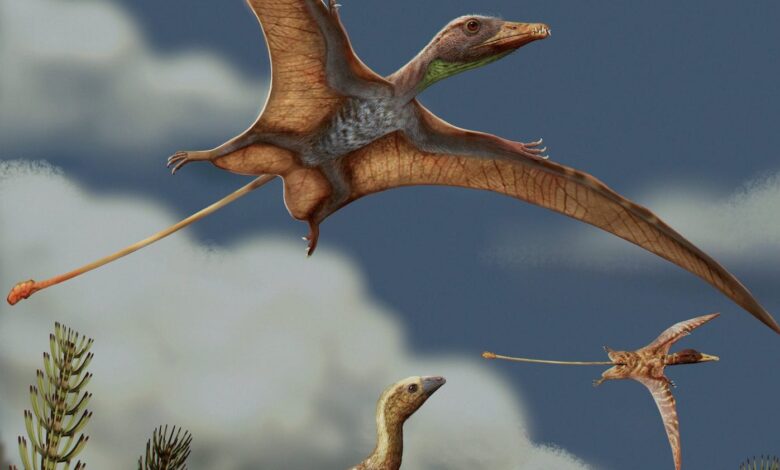
Paleontological discoveries in recent years have shed light on how ancient flying reptiles and modern birds developed the ability to fly—through entirely different evolutionary mechanisms. Studies of the skulls of lagerpetids, close relatives of pterosaurs, have allowed scientists to examine in detail for the first time how the nervous system formed in the ancestors of the first flying vertebrates. These findings have not only changed our understanding of brain development in pterosaurs, but also demonstrated just how different their path to conquering the skies was compared to the evolution of birds.
Pterosaurs, which appeared about 220 million years ago, were the first vertebrates to master powered flight. Achieving this required not just wings and strong muscles, but also unique neuroanatomical adaptations. For a long time, scientists struggled to understand exactly how the brains of these animals evolved, as their skulls were rarely preserved as fossils. Recent discoveries in South America have filled this gap and made it possible to compare their brains with those of birds and their ancestors.
Brain evolution: surprising discoveries
In the course of the study, specialists used CT scanning to create three-dimensional models of lagerpetid skulls, particularly the species Ixalerpeton polesinensis. Analysis showed that these terrestrial reptiles had elongated brains with relatively small hemispheres. This stands in sharp contrast to the brains of pterosaurs and birds, whose hemispheres are much wider than their hindbrains.
Interestingly, lagerpetids already showed a downward and lateral shift of the optic lobes—a trait typical of flying animals. Although lagerpetids themselves could not fly, this adaptation might have been linked to the need for good spatial orientation when climbing trees or hunting.
Evolutionary Leap: How Pterosaurs Rewired Their Brains
With the emergence of the first pterosaurs, their brain structure underwent dramatic changes. The olfactory bulbs shrank, while the hemispheres became rounder and larger. Most notably, the flocculus—a part of the cerebellum responsible for stabilizing vision as the head moves—stood out. In pterosaurs, this region reached sizes unseen in any other vertebrate, even surpassing the optic lobes.
Scientists link this unusual development of the cerebellum to the unique structure of pterosaur wings. Their wings were skin membranes crisscrossed with sensitive fibers and muscles, turning them into vast tactile organs. The cerebellum processed information coming from the wings, enabling the animal to instantly react to changes in airflow and keep its gaze firmly locked on prey.
Birds: Gradual Perfection in Flight
Unlike pterosaurs, the evolution of bird brains followed a different path. Their ancestors—the maniraptoran dinosaurs—began to develop complex nervous systems and sharp vision long before the first feathered species appeared. By the time birds learned to fly, their brains were already equipped to process the complex information required for flight. This process is called exaptation—when an organ or system originally evolved for one function is later used for another.
Birds made only minor modifications to the brain structure inherited from their ancestors, whereas pterosaurs underwent a true evolutionary leap, developing a unique neuroanatomical configuration. This allowed them to quickly adapt to life in the air and occupy the niche of aerial predators.
New findings reshape our understanding of flight evolution
A comparative analysis of the brains of lagerpetids, pterosaurs, and birds has shown that the evolution of flight in these groups followed entirely different scenarios. While brain development in birds occurred gradually, pterosaurs underwent a rapid transformation marked by the emergence of new structures not previously seen in vertebrates. This discovery highlights how diverse evolutionary paths can be, even when they lead to similar end results.
Modern research methods, such as CT scanning and 3D modeling, provide scientists with unique data on the brain structure of long-extinct animals. These technologies make it possible not only to reconstruct their appearance, but also to understand how their nervous systems worked and what evolutionary challenges they addressed.
FYI: What are pterosaurs and why are they important to science?
Pterosaurs were a large group of extinct flying reptiles that lived from the Late Triassic to the end of the Cretaceous period. They were the first vertebrates to develop powered flight, long before birds and bats appeared. Pterosaur size ranged from small species with a wingspan of about a meter to giants like Quetzalcoatlus, whose wings could reach 10–12 meters. They had lightweight skeletons, elongated fingers, and leathery wings, making them excellent fliers. Their diversity and adaptation to various ecological niches continue to fascinate paleontologists. Studying pterosaurs helps us understand how evolution can lead to the emergence of complex life forms and new ways of moving. Moreover, their unique neuroanatomy offers key insights into how the brain can rapidly change under the pressure of new environmental conditions.