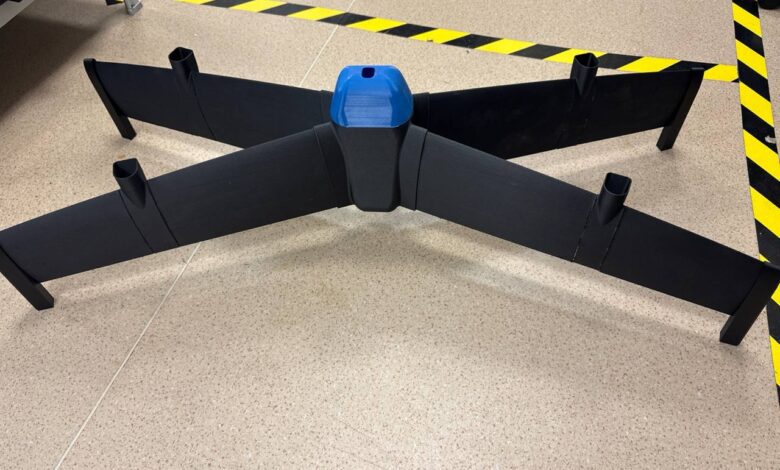
A group of Russian engineers has tested a prototype unmanned aerial vehicle capable of vertical takeoff and landing, as well as transitioning to horizontal flight without the use of traditional mechanical actuators. The new drone, named «ХАН», is controlled solely by software—using intelligent thrust distribution among its electric motors. This approach eliminates complex kinematic components, significantly simplifying the design and enhancing its reliability.
The core concept is based on the complete elimination of servos and rotating mechanisms typically used to shift flight modes. Instead, all maneuvers are achieved through precise adjustment of each engine’s power. This solution not only lightened the aircraft but also unlocked new possibilities for scaling the technology.
New architecture
The developers proposed several design options that allow the drone to take off like a helicopter, then smoothly switch to airplane mode and later return to a vertical landing. All these transitions happen without mechanical elements—relying solely on software algorithms and precise thrust control.
This approach provides high stability in flight, improves maneuverability, and reduces the device’s weight. Moreover, eliminating complex mechanics lowers the risk of malfunctions and simplifies drone maintenance.
Software-based control
Instead of the traditional mechanical solutions used in aviation, engineers have implemented a system where each engine is controlled independently. This allows the aircraft to react instantly to changing conditions, maintain stability even in strong winds, and perform complex maneuvers without risking mechanical failures.
The use of intelligent thrust control algorithms has become a key advantage of the new design. As a result, the drone can carry out missions that previously required complex and heavy structures.
Testing and development
The team is currently conducting comprehensive prototype tests. Special attention is being paid to transitional modes—those moments when the aircraft changes its flight direction or switches from one mode to another. Stability in various weather conditions, power consumption, and the effectiveness of the stabilization software algorithms are also being tested.
At the same time, work is underway to improve the software suite that forms the core of the entire control system. In the near future, the plan is to develop a full line of drones based on the new aerodynamic configuration. Aircraft with wingspans ranging from one to four meters will be able to handle a wide variety of tasks, from educational and experimental to industrial and surveying.
Composite materials
Another key aspect of the project was the introduction of advanced composite materials into the body structure. The team has already developed equipment for producing ultra-lightweight reinforcing materials and has refined a process for manufacturing polymer composite parts in a single production cycle.
Testing showed that these materials provide the necessary strength while minimizing weight—an especially important factor for unmanned systems. This creates a solid technological base for further development of domestic UAVs.
The project’s future
In 2026, the developers plan to continue working on aerodynamics, release new prototypes, and expand the use of composite technologies. They also intend to file applications for intellectual property registration, which will help protect unique solutions and secure their leadership in this field.
The project will serve as a foundation for new research directions and will be incorporated into educational programs, preparing specialists capable of creating innovative products for the aviation and space industries.
In case you didn’t know, PISH KAI (the Volga Institute of Modern Technologies of the Kazan Aviation Institute) is a research and educational platform where young engineers can bring their own ideas to life through real projects. The institute’s temporary scientific teams regularly participate in developing advanced solutions for aviation and high-tech industries, while graduates become highly sought-after professionals in the job market.