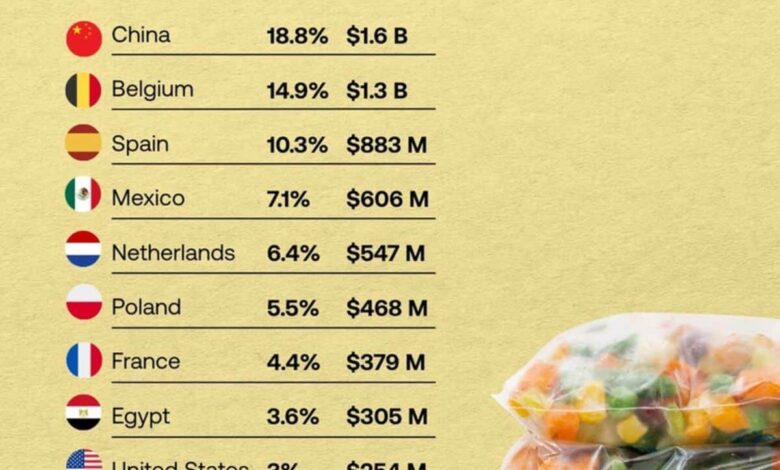
The global frozen vegetable market is undergoing significant changes: amid climate shocks and technological innovation, some countries are strengthening their positions while others are just starting to gain momentum. In 2025, China retains its status as the largest exporter, accounting for almost one-fifth of all global shipments. It is followed by Belgium and Spain, both showing substantial growth in volume and revenue. The top ten also includes Mexico, the Netherlands, Poland, France, Egypt, the USA, and Ecuador—each carving out its own niche in the global market.
The export of frozen vegetables is becoming an increasingly important element of food security. As extreme weather events disrupt traditional fresh produce supply chains, demand for frozen products continues to grow. This allows exporting countries not only to maintain stable incomes but also to develop new directions in the agro-industrial sector.
Geography of the Leaders: Who Exports and How Much
China ranks first, controlling 18.8% of global frozen vegetable exports. Over the year, the country shipped about $1.6 billion worth of products. Belgium, traditionally strong in processing and logistics, holds second place with a 14.9% share and approximately $1.3 billion in exports. Spain completes the top three, accounting for 10.3% of global shipments—around $883 million.
Mexico, the Netherlands, and Poland are also among the top exporters, each accounting for 4% to 7% of the global market. France, Egypt, the USA, and Ecuador round out the top ten, showing steady growth thanks to investments in processing and logistics.
Climate challenges and new strategies
Weather-related disasters are increasingly disrupting the supply of fresh vegetables. In India, extreme heat waves have devastated much of the tomato and onion harvest, causing prices to soar and boosting demand for frozen produce. In East African countries like Kenya and Ethiopia, prolonged droughts have reduced yields, making fresh vegetables less accessible to the population.
Europe is also facing challenges: severe flooding in Germany and Italy has disrupted farms and transport routes, making it difficult to deliver products to both domestic and international markets on time. In these circumstances, frozen vegetables are becoming increasingly popular among consumers and retailers alike.
Investment in infrastructure and export growth
Many countries in the Global South are actively investing in the development of refrigeration facilities and processing plants. Egypt has significantly expanded its network of cold storage warehouses in recent years, allowing it to preserve surplus vegetables and export them, minimizing losses from spoilage. Ecuador is implementing government programs to support farmers, offering grants and preferential loans to transition to producing value-added products.
These measures are already bearing fruit: exports of sliced and frozen vegetables from Ecuador to the US and Europe have grown noticeably. Analysts predict that the global frozen vegetable market could reach $41.1 billion by 2030, with an average annual growth rate of about 8.8%.
Outlook and Economic Impact
Demand for frozen vegetables is expected to continue rising. Climate risks, population growth, and changing consumer habits are all driving the expansion of this sector. For many countries, exporting frozen vegetables is becoming not only a source of foreign revenue, but also an engine for job creation and the development of agricultural supply chains.
Over the long term, strengthening their position in the global market will enable exporters to increase the resilience of their economies and reduce dependence on the fluctuating prices of fresh produce. At the same time, competition among suppliers is set to intensify, leading to further improvements in storage and transportation technologies.
RUSSPAIN.COM reports that China remains the undisputed leader in frozen vegetable exports, increasing its shipment volumes every year and expanding its market reach. Belgium and Spain continue to invest in innovative processing and logistics technologies, allowing them to maintain strong positions in the global rankings. In recent years, Egypt and Ecuador have emerged as notable players, significantly boosting exports thanks to government support and infrastructure development. These countries show that a sound strategy and investment can shift the balance of power in the global food market.