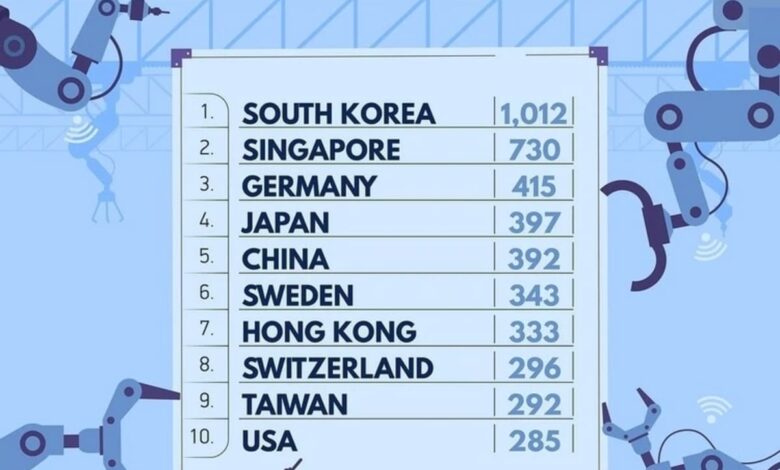
In recent years, automation has become a key driver of industrial development in many countries. The introduction of industrial robots enables companies to increase efficiency, reduce costs, and remain competitive in the global market. The International Federation of Robotics publishes annual data on robot density in manufacturing, and in 2025, this ranking has changed once again.
Leaders in Industrial Robot Density
South Korea continues to hold the top spot globally for the number of industrial robots per 10,000 employees. Here, each 10,000 workers operate more than a thousand automated machines. This achievement is possible thanks to the country’s strong presence in electronics and automotive industries, where automation has become the norm.
Singapore ranks second on the list. In this small but highly advanced nation, robot density exceeds 700 units per 10,000 employees. Local companies actively adopt automation solutions, especially in electronics and precision engineering.
Germany leads Europe in industrial automation, with more than 400 robots per 10,000 employees. Its developed automotive industry and engineering traditions drive the continuous growth of automation.
Asia and Europe’s Technology Giants
Japan, renowned for its robotics innovations, ranks fourth. The country has nearly 400 robots per 10,000 employees. Japanese companies actively use automation in car and electronics manufacturing, enabling them to maintain high standards of quality and productivity.
China has made a rapid leap in automation in recent years. There are now over 320 robots for every 10,000 employees. Massive investments in industry and new technologies have helped China become one of the top five countries in robot density.
Sweden also demonstrates a high level of automated systems adoption. The country has almost 290 robots per 10,000 workers. Local enterprises prioritize innovation and the digitalization of production processes.
Regions leading in automation
Hong Kong, despite its small size, actively deploys industrial robots. The region has more than 240 automated machines per 10,000 employees. Hong Kong aims to maintain its status as one of the world’s leading trade and manufacturing hubs.
Switzerland is known for its high-tech industries, especially in pharmaceuticals and food production. The country boasts over 240 robots per 10,000 workers. This allows Swiss companies to maintain high product quality and optimize manufacturing processes.
Thanks to its powerhouse electronics and semiconductor sectors, Taiwan also ranks among the top ten. The country has more than 230 robots for every 10,000 employees. Automation has become an integral part of local manufacturing chains.
The US and New Trends in Automation
The United States rounds out the top ten countries with the highest density of industrial robots. In American industry, there are over 220 automated machines for every 10,000 workers. Robot adoption is particularly active in automotive, aerospace, and electronics manufacturing. Companies are aiming to boost productivity and reduce reliance on human labor.
Overall, the ranking shows that automation is becoming a global trend. Countries investing in robotics gain a competitive edge and set new benchmarks for the world’s manufacturing sector.
The Impact of Automation on the Economy and Job Market
The rising number of industrial robots affects not only productivity, but also the structure of the workforce. Leading countries see the emergence of new jobs in the servicing and programming of automated systems. At the same time, some traditional positions are gradually disappearing, which calls for adaptation of educational programs and retraining of staff.
Experts note that automation drives innovation and stimulates economic growth. However, it also presents new challenges for society, including the need for social protection and the creation of new jobs in related sectors.
In the coming years, robot density in manufacturing is expected to continue rising, especially in countries with advanced industries and high levels of investment in technology.
In case you didn’t know: The International Federation of Robotics and its role
The International Federation of Robotics (IFR) is the world’s leading organization uniting manufacturers, researchers, and users of industrial and service robots. Founded in 1987, the federation collects and analyzes robotics market statistics and promotes industry standards and best practices. IFR publishes annual reports on the state of the market, highlighting key trends, automation adoption dynamics, and industry forecasts. The organization actively collaborates with national associations, universities, and industrial companies worldwide. Thanks to its efforts, businesses and government bodies gain reliable information for investment and technology development decisions. IFR also organizes international conferences and exhibitions where the latest advances and future prospects in robotics are discussed. In recent years, the federation has focused especially on ethics, safety, and the social impact of automation. Its analytics are widely used in academic research, strategic planning, and educational programs. The International Federation of Robotics is regarded as an authoritative data source for professionals and journalists covering automation and the digital transformation of industry.