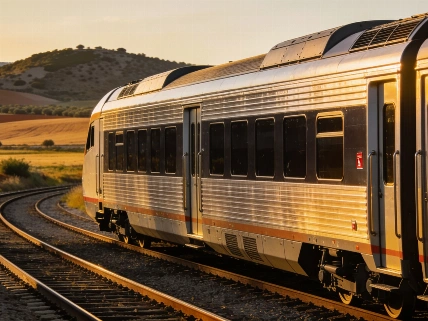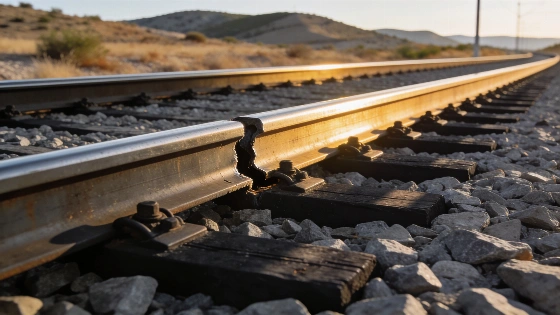
Forty-seven trains crossed the broken rail near Adamuz before the Iryo derailed, according to a draft report by Spain’s rail accident investigation authority. The break occurred about 22 hours before the crash on 18 January 2026, which killed 46 people and injured more than 150. No alarm was triggered.
The Autoridad Administrativa Independiente para la Investigación Técnica de Accidentes e Incidentes Ferroviarios (Aitat) sent the draft to Montoro judge Cristina Pastor. It says the track circuits used to monitor train locations are not designed to guarantee detection of every type of rail fracture. Aitat warned that safety deficiencies remained unaddressed. The defect remains uncorrected, the investigators say.
By analysing changes in electrical tension, investigators placed the complete break after Renfe train 2211 passed at 21:47 on 17 January. The Iryo 6189, travelling from Málaga to Madrid, reached the same point about 22 hours later. It derailed and collided with an Alvia train.
The report says other trains continued to cross the damaged section during that interval. Rail fractures can alter track geometry and shift the rails, creating a derailment risk. Track circuits are signalling and train-detection systems, not dedicated rail-integrity monitors. They can detect some breaks when a fracture interrupts the electrical circuit, but not every kind. Their operation also depends on electrical conditions, including wheelset impedance and wheel–rail contact resistance. The system at Adamuz did not identify this break, despite a change in tension.
The figures in the draft point to a wider detection gap. Since 2017, investigators have recorded 44 rail breaks across the Adif network. Track circuits detected 18, or 40.91%; maintenance staff found 17, and drivers reported the remaining nine. That amounts to four or five breaks a year. The report says established systems and procedures do not always detect them. The European Union Agency for Railways lists broken rails among its common safety indicators, alongside track buckles and signals passed at danger. Its list also covers wrong-side signalling failures, as well as broken wheels and broken axles. The agency’s 2026 safety report uses indicator data for 2024 and does not include the Adamuz accident.
Aitat says early detection is a critical safety function under the criteria of the European Union Agency for Railways and Spanish legislation. It concludes that detecting the break would, in all probability, have prevented the Iryo derailment and the subsequent collision. The investigators recommend technical measures that can identify complete rail fractures early, with sufficient detection rates and reliability.
The document is provisional. Aitat president Gonzalo Guillén described it as a working draft that had not been formally approved or considered by the authority; the final report may differ. The draft followed a request from Pastor on 6 November for information on the investigation. EL MUNDO reported that it had access to the document.
Separate preliminary evidence sent to the judge by three court-appointed experts points to a possible defective weld from renewal work carried out in 2025, along with movement in the ground beneath the track. In a report dated 20 November, the experts identified a failed weld and ground movement as the most probable causes, with dynamic stresses amplified by track deformation also implicated. They observed a 6.4-millimetre vertical dip in one rail and are examining whether the resulting geometry placed additional loads on the opposite rail. The weld may have been poorly executed where rails of different ages and hardness were joined. The experts also cautioned that several visible breaks could have resulted from the Iryo train’s impact.
The experts said the resulting unevenness could have contributed to weld failure. The Guardia Civil reported that the dip was found at the break point in September 2025 and corrected, then reappeared in October. Adif inspected it in November and found it had grown. It was not examined again before the crash. The court-appointed report said there was no record of monitoring the defect’s evolution and called for Adif to provide earlier rail-profile measurements.
Adif also asked Renfe, through the Montoro court, for accelerometer records from trains that travelled through the section between Villanueva de Córdoba and the junction at Alcolea on 17 and 18 January. The records are being sought to establish whether trains experienced abnormal accelerations or other signs of track anomalies before the derailment. The disassembly of the affected Iryo train was halted while evidence was preserved.
The maintenance question also featured in a report on Adif funding, which estimated a €780 million maintenance shortfall in September 2025. The Aitat draft addresses a separate issue: whether the safety system can identify a broken rail before another train reaches it.