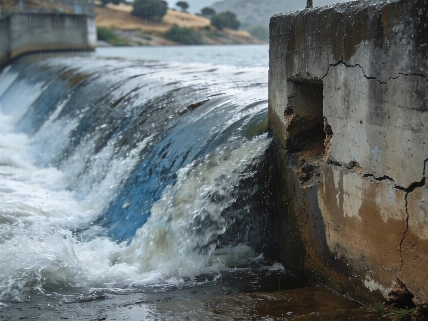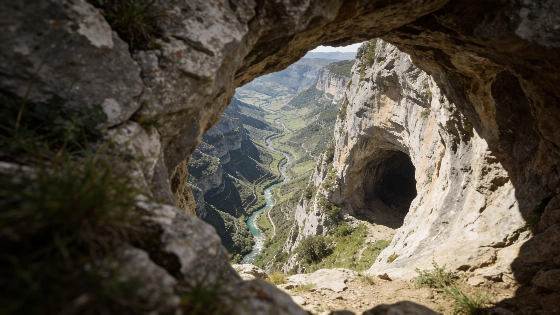
Sediments inside Cueva de Llamazares show that the Curueño flowed at roughly the cave’s present elevation about 500,000 years ago. The river now runs around 280 metres below it, after progressively cutting into the landscape. The deposits preserve the former river level and record how the valley has changed.
The study estimates that the river has incised its valley at 0.5-0.6 millimetres a year. That average reflects both uplift of the surrounding terrain and river erosion, rather than a uniform rate of tectonic movement. Nearby faults may have raised the ground locally, helping explain why incision here was faster than elsewhere in the Duero basin. La Nueva Crónica reported that the inferred renewed fault movements displaced the ground by several tens to a few hundred metres over the past 500,000 years.
The faults formed during the Carboniferous period, around 330 million years ago, and were active as the Cantabrian Mountains took shape. The findings indicate that these ancient structures moved again during the past half-million years. Researchers base that interpretation on river sediments preserved in the cave, which record the Curueño’s former elevation.
The result adds evidence of Quaternary landscape uplift in northern León. The main uplift of the Cantabrian Mountains followed the collision of the Iberian and European tectonic plates between roughly 80 and 30 million years ago. This new evidence points to further, more recent movement in the Curueño headwaters, extending the geological history of the range beyond its principal uplift phase.
Daniel Ballesteros led the research in collaboration with the universities of León and Cantabria. Published in Quaternary Science Reviews, it also establishes Cueva de Llamazares as the oldest dated cave in León province, with a recorded history of at least half a million years. Other caves higher above the valley may be older, but researchers have not yet dated them.
The geological timescale examined here differs sharply from the immediate chronology in RUSSPAIN’s report on the Los Yébenes rail crash. The cave research is part of the Frontera Cantábrica project, funded by Fundación Patrimonio Natural and carried out with the Universidad de León and two bodies within the Junta de Castilla y León: the Servicio Territorial de Medio Ambiente de León and GRIA de León.
The wider project is co-directed by Esperanza Fernández of the Universidad de León’s palaeontology area and Darío Fidalgo of Berlin’s Museum of Natural Sciences. Earlier work by the team identified remains of brown bears and chamois in the cave, as well as wild horses dated to between 9,000 and 2,000 years ago.